Discover what drives custom PCB costs in 2025, from material choices and layer counts to board size and production volume. Compare area-based pricing for prototypes with detailed cost calculations for bulk orders. Unlock cost-saving strategies to balance quality and budget for your industrial & electronics projects.
Introduction
In 2025, custom PCBs continue to be the backbone of modern electronics, powering everything from IoT devices and electric vehicles to medical equipment and 5G infrastructure. However, with rising material costs, supply chain complexities, and evolving design requirements, managing PCB expenses is a top concern for engineers, startups, and manufacturers alike.
The cost of a custom PCB can vary widely—from $5 for a simple prototype to thousands for a high-density, multi-layer board for aerospace applications. Factors like material selection, layer count, board size, and production volume play a critical role, but emerging trends such as sustainable materials and automated manufacturing are reshaping the cost landscape in 2025.
This guide reveals the key factors driving custom PCB costs and shares actionable strategies to save up to 30% without compromising reliability.
Major Factors Determining Custom PCB Cost
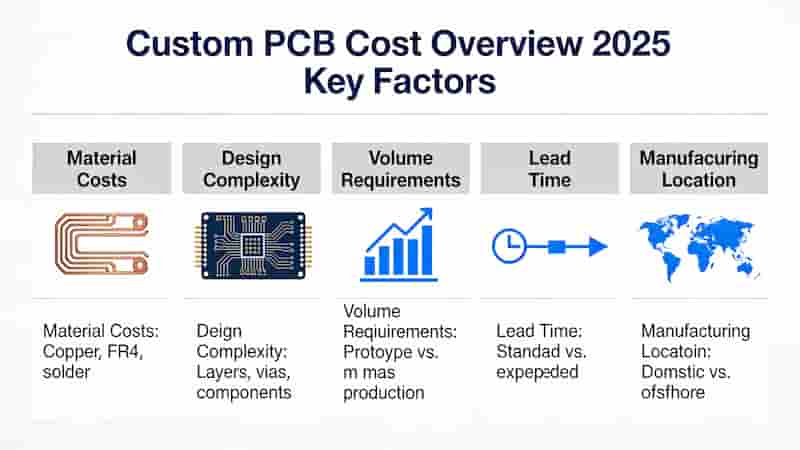
The cost of custom printed circuit boards hinges on several critical factors that influence both design and manufacturing expenses. Understanding these drivers allows you to optimize your PCB projects for performance and budget in 2025’s dynamic electronics landscape.
1. PCB Base Material
The substrate material forms the foundation of a PCB and significantly impacts its cost and performance. Standard materials like FR-4 are cost-effective, while specialized substrates like Rogers or ceramic cater to high-frequency or high-reliability applications but come at a premium.
2. Number of Layers
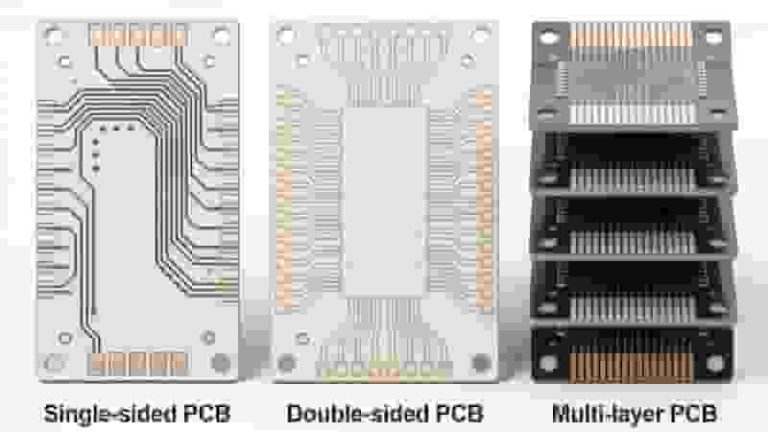
The number of copper layers in a PCB directly affects its complexity, manufacturing time, and cost. Single- and double-layer boards are economical, while multi-layer boards (4+ layers) increase expenses due to intricate stackups and alignment challenges.
3. Board Size and Dimensions
Larger PCBs require more raw materials and pose manufacturing challenges, such as maintaining precision over larger areas, which drives up costs. Boards exceeding 500 sq. cm often incur additional handling fees.
4. Production Volume
Economies of scale play a pivotal role in custom PCB costs. High-volume orders spread setup costs (e.g., tooling, stencil creation) across more units, reducing per-unit costs.
5. Manufacturing Processes
Specialized processes like heavy copper plating, controlled impedance, or advanced surface finishes (e.g., ENIG) increase costs due to additional equipment and expertise required.
6. Minimum Trace Width and Spacing
Finer trace widths and smaller spacing increase manufacturing complexity, requiring advanced equipment and stricter quality control. Traces below 6 mil or spacing below 8 mil demand high-precision photolithography.
7. Certifications and Testing
Certifications (e.g., UL, IPC-A-600) and additional testing (e.g., thermal cycling, electrical testing) ensure reliability but add costs due to specialized processes and documentation.
| Factor | Cost Impact | Typical Cost Range | Optimization Tip |
|---|---|---|---|
| Base Material | High | $1–$200/sq. ft. | Use FR-4 for standard applications |
| Layer Count | High | $2–$15/sq. ft. | Minimize layers with efficient routing |
| Board Size | Medium | $5–$50/board | Optimize dimensions and panelize |
| Production Volume | High | $2–$10/unit | Order in bulk for economies of scale |
Cost of Different PCB Materials
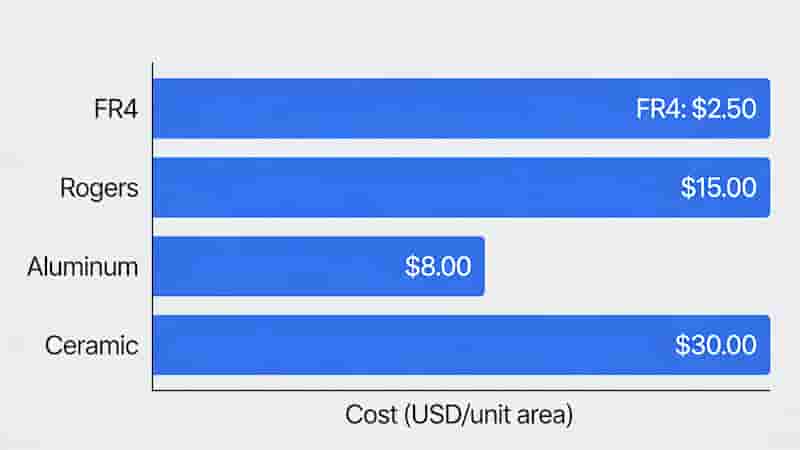
The choice of base material is a pivotal factor in determining custom PCB costs and performance. Each material offers unique electrical, thermal, and mechanical properties tailored to specific applications.
| Material | Cost per Sq. Ft. | Key Properties | Typical Applications |
|---|---|---|---|
| FR-4 | $1–$10 | Versatile, cost-effective | Consumer electronics, IoT |
| Rogers | $20–$50 | Low dielectric loss | 5G, RF, microwave |
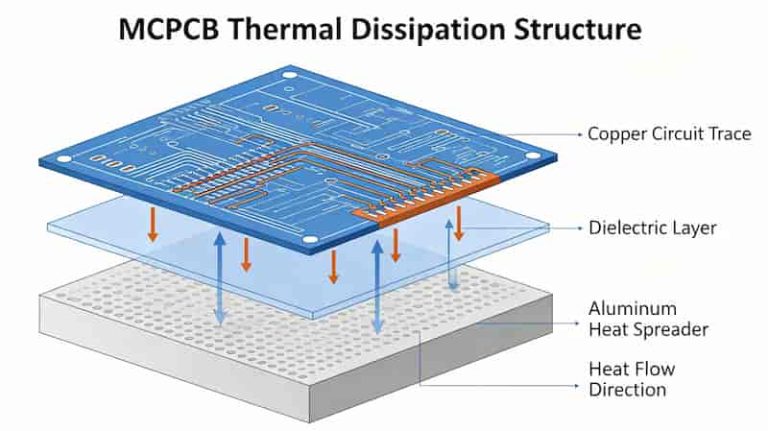
| Aluminum | $10–$20 | High thermal conductivity | LED, power electronics |
| Polyimide | $5–$20 | Flexible, high temp | Wearables, medical |
| Ceramic | $50–$200 | Extreme performance | Aerospace, high-rel |
Calculating PCB Costs by Size
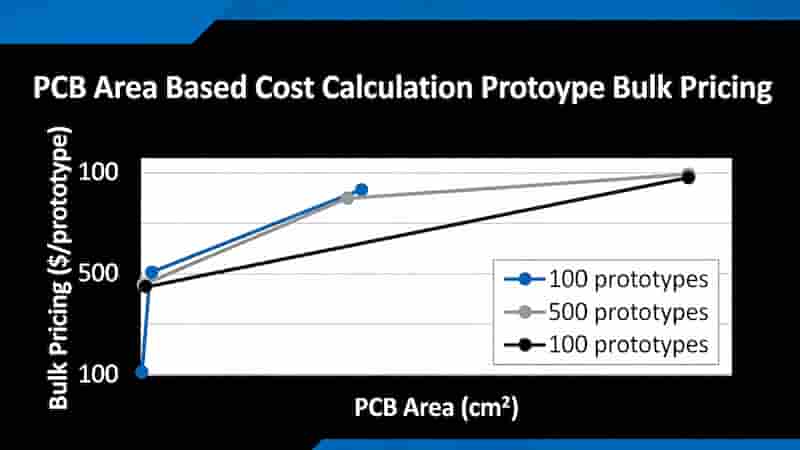
Area-based pricing is a straightforward and widely used method for estimating custom PCB costs, particularly for prototyping and low-volume production.
Formula: Total Cost = Board Area (sq. cm) × Unit Price × Quantity
Unit price varies by layers, material, and processes. For standard FR-4 in 2025:
- 1–2 layers: $0.01–$0.05 / sq. cm
- 4 layers: $0.05–$0.10 / sq. cm
- 6–8 layers: $0.08–$0.25 / sq. cm
Detailed PCB Cost Calculations
For high-volume production or complex designs, detailed cost calculations provide a more accurate estimate by accounting for materials, layers, processes, drilling, tooling, labor, and overhead.
Typical cost breakdown for a 4-layer custom PCB in 2025:
- Raw Materials: 35–45%
- Layer Count & Stack-up: 25–35%
- Manufacturing Processes: 15–25%
- Drilling & Vias: 5–10%
- Tooling & Setup: 5–10%
- Labor & Overhead: 5–15%
Using Online PCB Pricing Calculators
Online PCB pricing calculators provide instant cost estimates by processing key design parameters, helping you quickly evaluate custom PCB costs for prototypes and production.
Key inputs include board dimensions, layer count, material, quantity, surface finish, and lead time. Advanced tools in 2025 support Gerber file analysis for higher accuracy.
2025 PCB Cost Trends
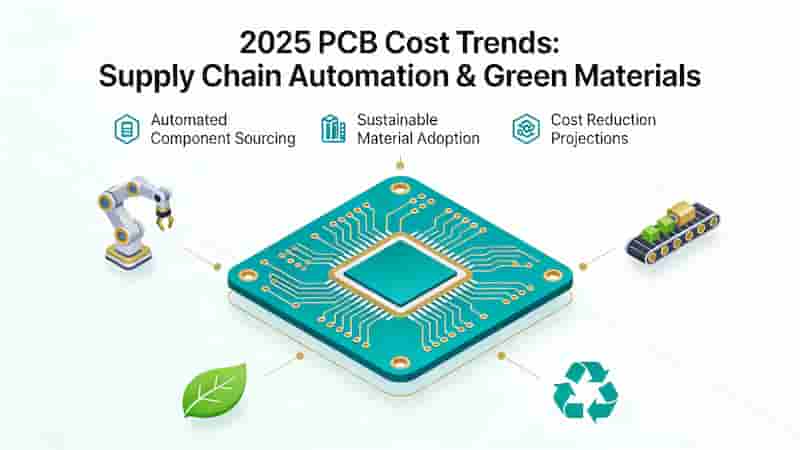
The PCB industry is evolving rapidly in 2025, driven by supply chain shifts, sustainability demands, automation, and technological advancements that directly affect custom PCB costs.
- Material prices increase 5–15% due to global supply shortages
- Sustainable & halogen-free materials add 10–20% cost
- Automation reduces labor cost by 10–15% for mass production
- Asian manufacturing remains 10–20% more cost-effective
- HDI and microvia processes raise cost but enable miniaturization
How to Reduce Custom PCB Costs
You can lower custom PCB costs by 15–40% without sacrificing quality using these proven strategies:
- Optimize layer count and avoid over-engineering
- Use FR-4 unless high-performance materials are required
- Increase order volume to amortize tooling cost
- Choose HASL over expensive surface finishes
- Avoid ultra-fine traces and unnecessary microvias
- Use panelization to reduce material waste
- Select standard lead time to avoid rush fees
Get Your Custom PCB Quote Today
We provide reliable, cost-effective custom PCB manufacturing for global buyers, supporting prototypes, medium batches, and mass production with full industrial quality standards.
Send us your Gerber files and BOM for a free, detailed quotation. Our engineering team provides DFM review to optimize your design and reduce custom PCB costs before production.
Request Free PCB Quote