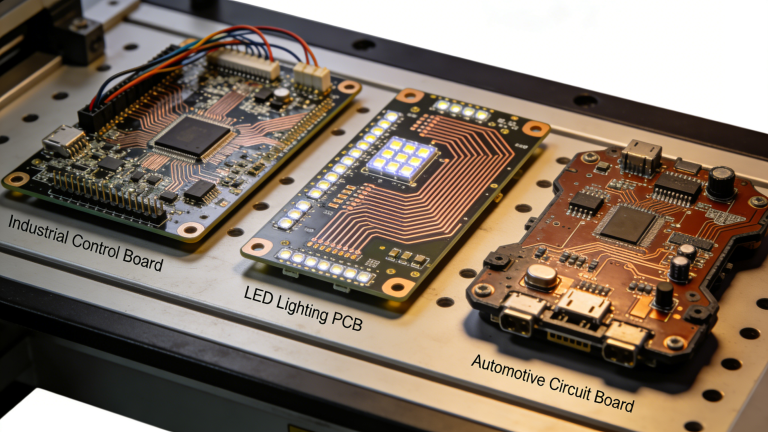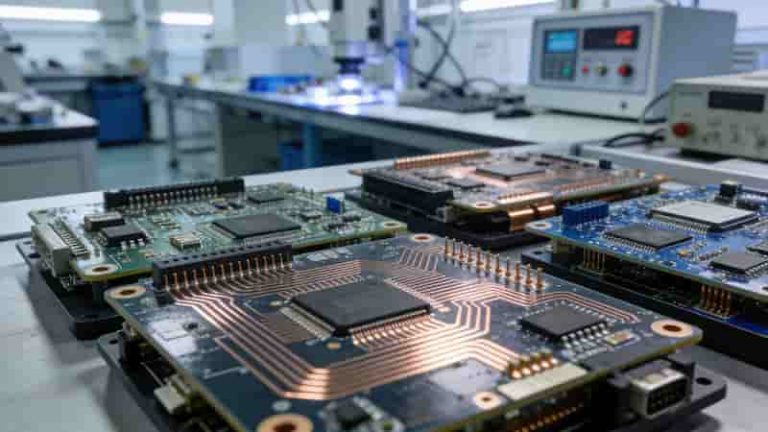
Rogers PCB is the leading solution for high‑frequency electronics. This guide covers properties, types, benefits, applications, and comparisons between Rogers PCB, FR‑4, and Teflon PCBs, ideal for engineers and manufacturers looking for advanced circuit solutions.
What is Rogers PCB?
Rogers PCB refers to printed circuit boards using advanced laminate materials produced by Rogers Corporation. Unlike standard FR‑4 PCBs made with epoxy resin and glass fiber, Rogers PCB uses PTFE, ceramic‑filled composites, or hydrocarbon blends to deliver superior performance in high‑frequency environments.
These materials are engineered for minimal signal loss, stable dielectric properties, and strong thermal management, making Rogers PCB perfect for 5G antennas, radar systems, microwave circuits, and other mission‑critical applications.
Key Properties of Rogers PCB Materials
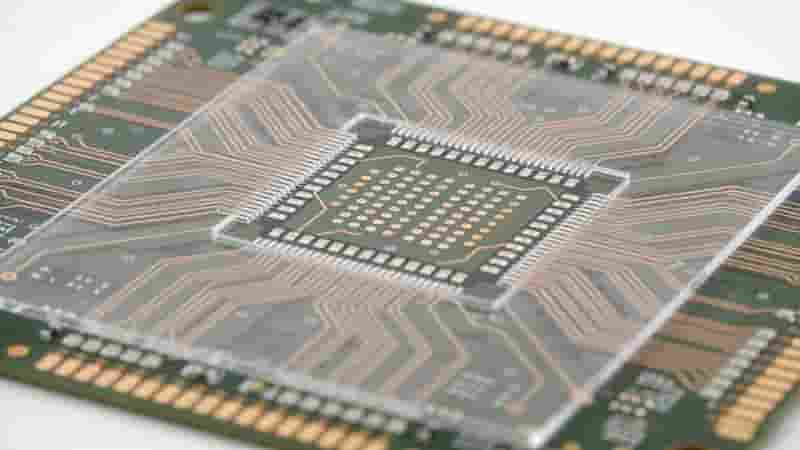
Rogers PCB materials are designed for demanding industrial and high‑frequency conditions. Core properties include:
- Low Dissipation Factor (Df): RO4003C™ offers Df 0.0027 at 10 GHz, greatly reducing signal loss.
- Stable Dielectric Constant (DK): Ranges from 2.2 to 10.2 for consistent broadband performance.
- Low Moisture Absorption: As low as 0.06% for RO4350B™, ensuring reliability in harsh environments.
- High Thermal Conductivity: Up to 0.69 W/m/K for RO4350B™, supporting efficient heat dissipation.
- Excellent Dimensional Stability: Maintains integrity across wide temperature ranges for RF designs.
Types of Rogers PCB Materials
Rogers Corporation provides a full lineup of high‑performance materials for Rogers PCB fabrication:
Laminates
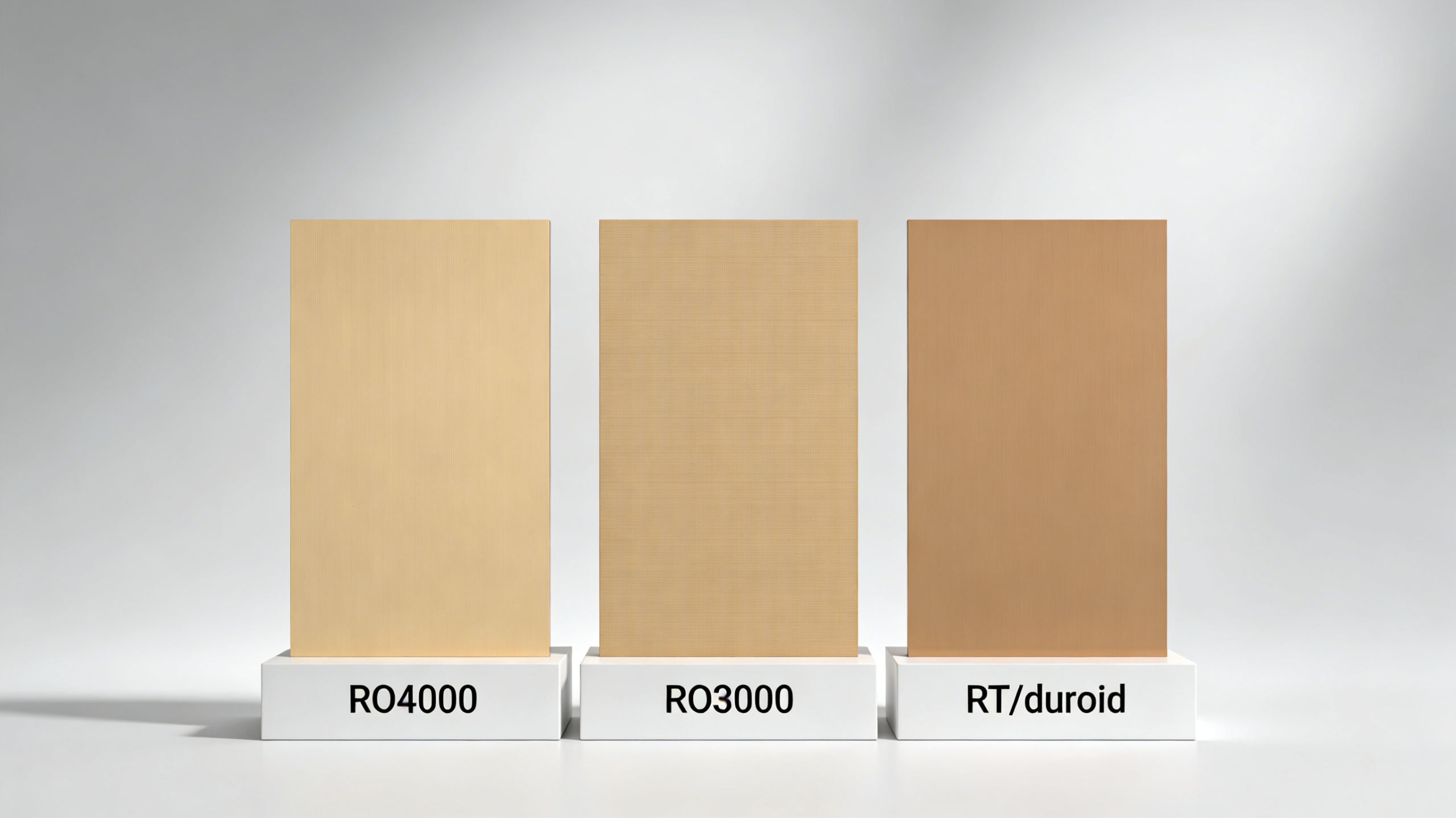
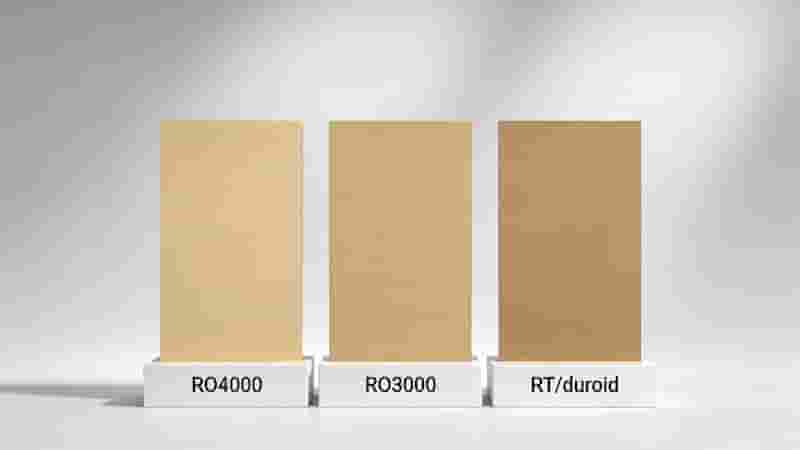
- RO4000® Series: Cost‑effective high‑frequency laminates (RO4003C™, RO4350B™) for 5G and automotive radar.
- RO3000® Series: Ceramic‑filled PTFE composites for microwave and RF systems.
- RT/duroid® Series: Ultra‑low‑loss PTFE materials for aerospace, defense, and satellite applications.
Bonding Materials
- Hydrocarbon/Ceramic Prepregs for multilayer PCB structures
- Thermoset Adhesive Films for improved thermal and electrical performance
- Ceramic PTFE Bondply for reliable high‑frequency bonding
Metal Claddings
- Electrodeposited Copper for uniform conductivity
- Resistive Foil for precise impedance control
- Reverse Treated Copper for strong multilayer adhesion
Benefits of Rogers PCB
Rogers PCB brings clear advantages for high‑performance electronic designs:
- Superior High‑Frequency Performance: Ultra‑low Df minimizes signal loss in 5G, microwave, and RF systems.
- Strong Thermal Management: Prevents overheating in power amplifiers, radar, and high‑power devices.
- Wide DK Range: Supports applications from small antennas to satellite communications.
- Harsh Environment Reliability: Low water absorption ensures stable performance in extreme conditions.
- Balanced Cost & Performance: RO4000® Series provides premium performance at a lower cost than pure PTFE.
Applications of Rogers PCB
Rogers PCB is widely used in advanced industries worldwide:
- Telecommunications: 5G base stations, antennas, microwave backhaul radios
- Automotive: ADAS radar sensors, autonomous driving systems
- Aerospace & Defense: Satellite communications, radar, RF identification systems
- Medical: High‑precision imaging and diagnostic equipment
- Industrial: Automated test equipment, high‑frequency power amplifiers
| Industry | Application | Typical Rogers Material |
|---|---|---|
| Telecom | 5G Antennas | RO4350B™ |
| Automotive | Radar Sensors | RO4003C™ |
| Aerospace | Satellite Communications | RT/duroid 5880 |
Rogers PCB vs FR‑4 vs Teflon PCB
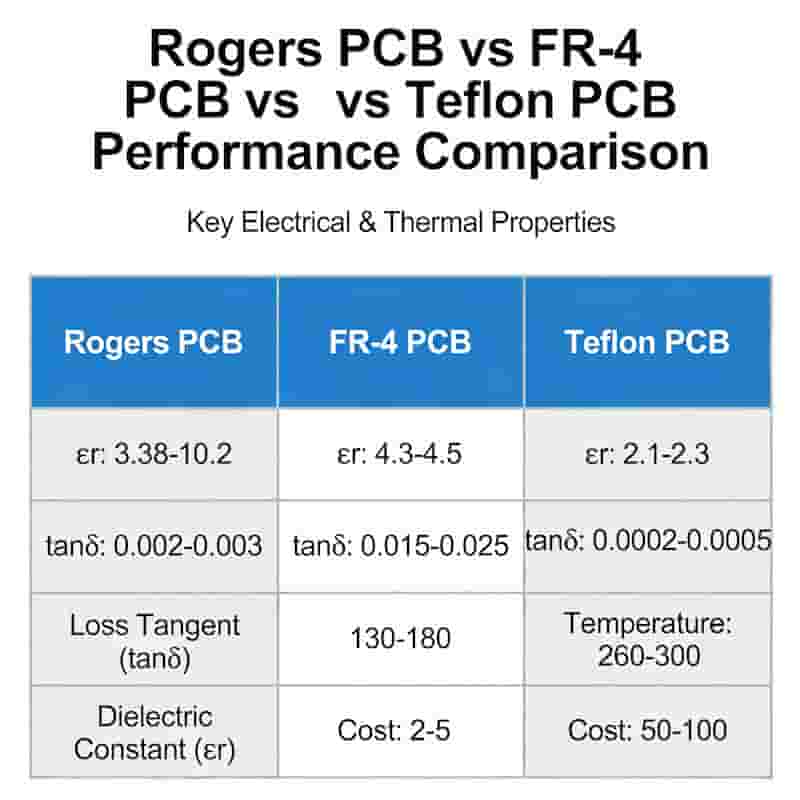
Rogers PCB vs FR‑4 PCB
| Feature | Rogers PCB | FR‑4 PCB |
|---|---|---|
| Dielectric Constant | 2.2–10.2 | ~4.4–4.7 |
| Dissipation Factor (10 GHz) | 0.0027 | ~0.02 |
| Thermal Conductivity | Up to 0.69 W/m/K | ~0.3 W/m/K |
| Best For | High‑frequency RF, microwave, 5G | General‑purpose consumer electronics |
Rogers PCB vs Teflon PCB
- Frequency Range: Rogers PCB supports up to 6+ GHz; Teflon PCB is often limited to 5 GHz.
- Material Stability: Rogers uses ceramic‑filled laminates for better dimensional and thermal stability.
- Application Scope: Rogers PCB fits high‑reliability industrial and automotive projects; Teflon suits simpler RF designs.
How to Choose a Reliable Rogers PCB Supplier
Selecting a professional supplier ensures the quality and performance of your Rogers PCB projects:
- Full access to RO4000®, RO3000®, RT/duroid® series materials
- Professional prototyping and mass production capabilities
- Compliance with UL 94 V‑0, IPC, and RoHS certifications
- Expert technical support for material selection and design optimization
- Stable lead times and secure international shipping
Conclusion
Rogers PCB sets the standard for high‑frequency, high‑reliability circuit boards. With excellent electrical properties, thermal stability, and broad industry adoption, it is the first choice for 5G, automotive radar, aerospace, and industrial RF applications.
Whether you need prototype development or mass production, we deliver certified, high‑quality Rogers PCB solutions to support your global projects.
Start Your Rogers PCB Project Today
Get a free DFM check, professional material advice, and an exact quote for your Rogers PCB design.
Request a Quote
Contact Engineering Team