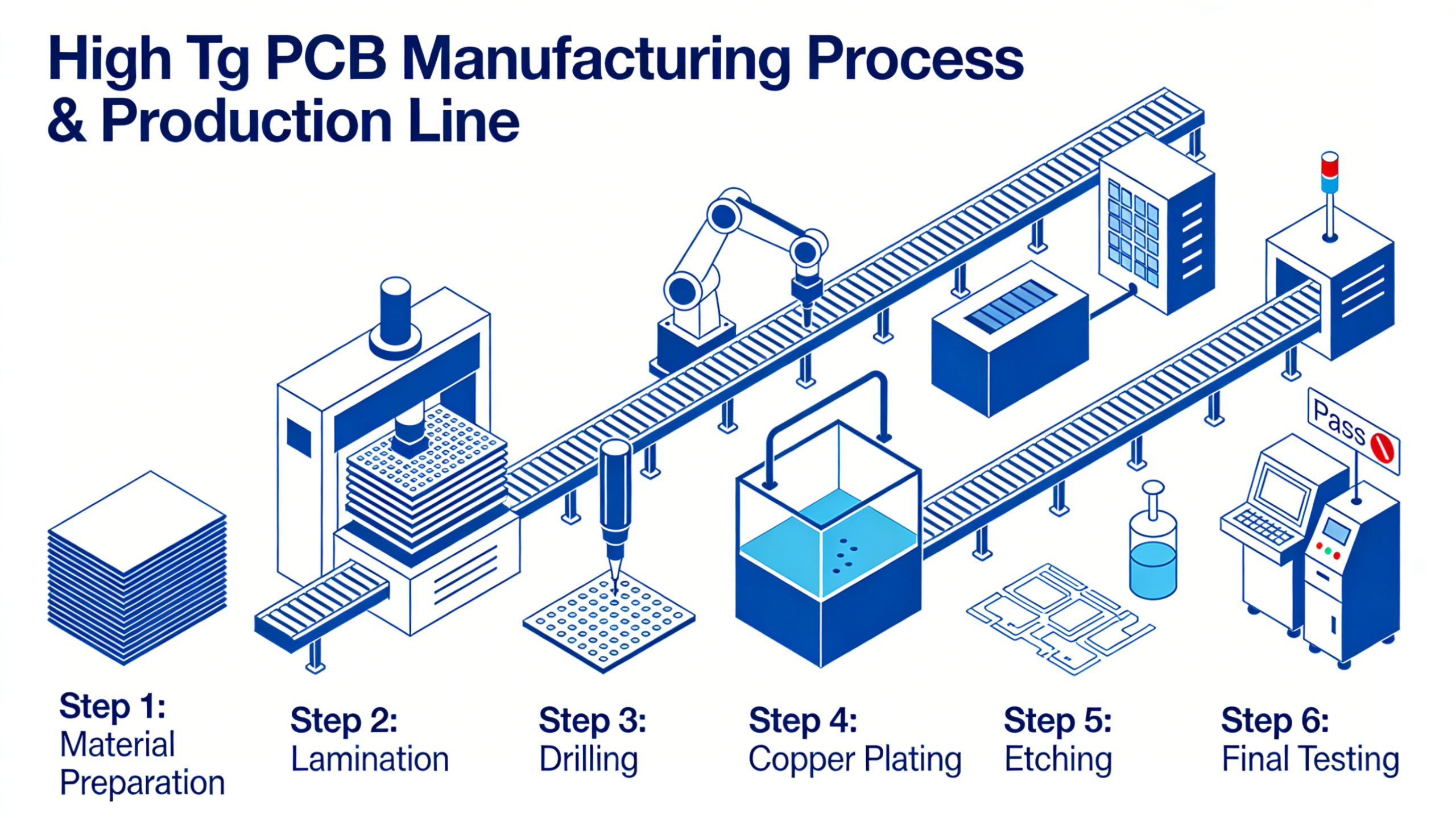
We manufacture reliable High Tg PCB boards using Tg 170–180+ FR‑4 materials, engineered for automotive, power electronics, industrial control, and telecom applications that must survive elevated temperatures and demanding duty cycles.
What Is a High Tg PCB
A High Tg PCB is a printed circuit board made with materials that have a higher glass transition temperature (Tg), so the board stays mechanically stable and reliable at elevated temperatures.
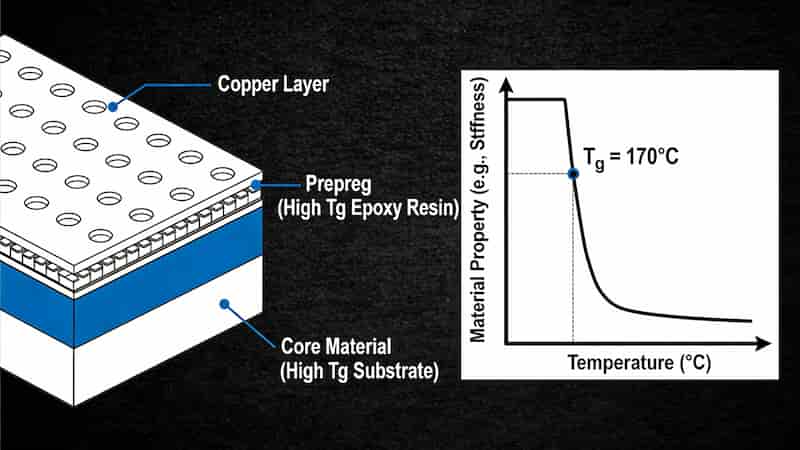
Tg is the temperature at which the PCB substrate changes from a hard, glassy state to a softer, rubber‑like state. When the operating or assembly temperature approaches this point, standard FR‑4 begins to warp, expand, or lose long‑term reliability.
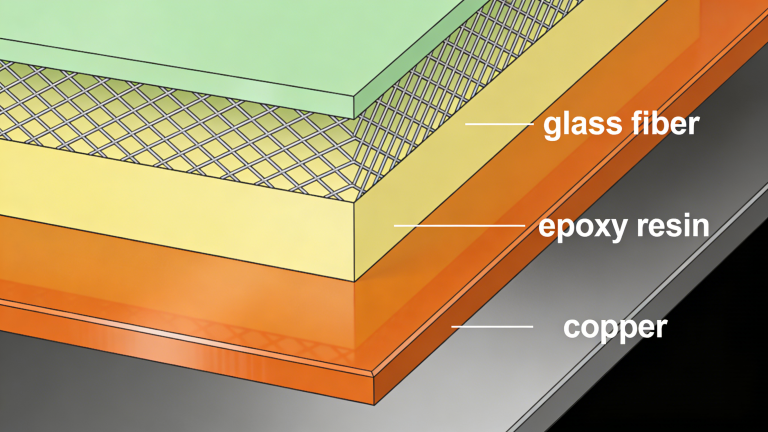
Standard FR‑4 materials typically have a Tg of about 130–140 ℃, while High Tg FR‑4 materials are engineered with Tg values of 170 ℃ or higher, and some ultra‑high Tg laminates even exceed 180 ℃.
Why High Tg PCB Matters for Your Design
High Tg PCB boards are not only about surviving high temperatures; they also keep your board flat, reliable, and electrically stable over the product’s lifetime.
- Improved thermal stability: Withstands higher operating and lead‑free reflow temperatures without softening or deformation
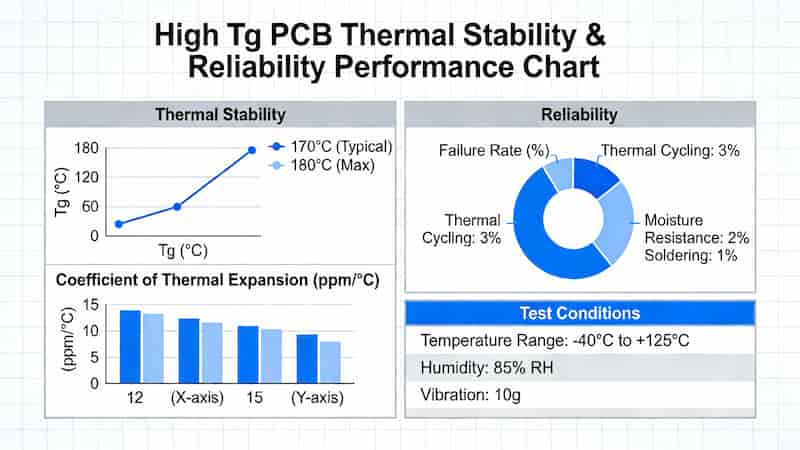
- Better mechanical reliability: Reduced warpage, lower delamination risk, and stronger PTH reliability under thermal cycling
- Consistent electrical performance: Stable dielectric and impedance behavior preserves signal integrity
- Ideal for high‑power, multilayer, and HDI designs used in automotive, industrial, and telecom fields
When Do You Need a High Tg PCB
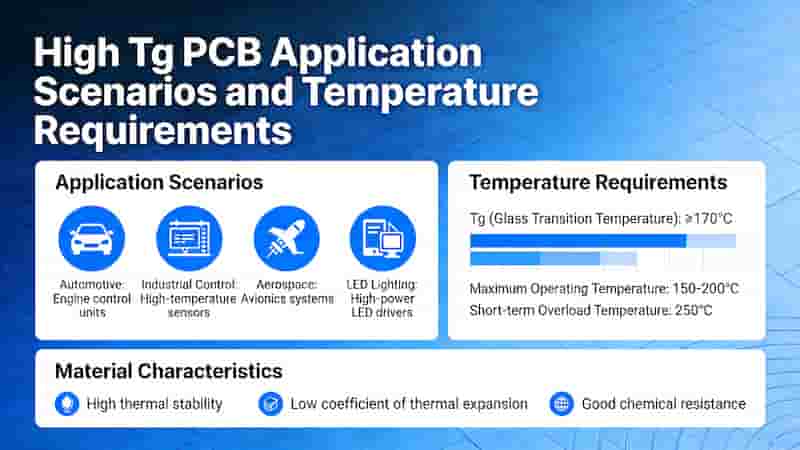
Standard FR‑4 works for general electronics, but you need a High Tg PCB in these scenarios:
- Max operating temperature reaches 130 ℃ or higher, with less than 25 ℃ safety margin
- High‑power components create high power density that exceeds standard FR‑4 thermal limits
- Multilayer / HDI design with blind/buried vias or thick copper exposed to repeated high thermal stress
- Lead‑free assembly with multiple high‑temp reflow cycles
- Harsh environments: engine compartments, industrial equipment, outdoor enclosures, high vibration or humidity
High Tg PCB Key Applications
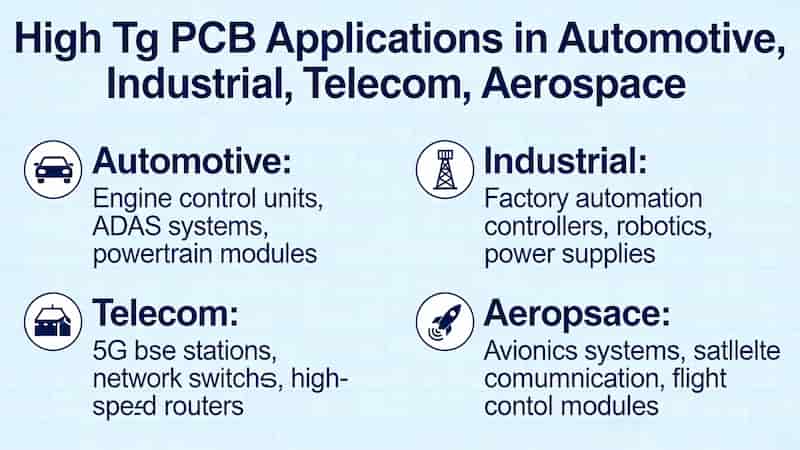
High Tg PCB supports mission‑critical electronics across industries:
Power and Industrial Control
High power converters, motor drives, PLCs, and factory automation need stable dimensional performance under continuous high loads.
Automotive and Transportation
ECUs, powertrain, OBC, and under‑hood electronics rely on High Tg PCB to avoid deformation and solder failure under extreme temperature cycles.
Aerospace and Defense
Avionics and control systems use High Tg PCB for extreme temperature and vibration endurance, ensuring mission reliability.
Telecom, Servers and HPC
5G base stations and high‑performance servers use High Tg PCB for dense, high‑power layouts requiring thermal stability.
High Tg PCB Materials and Specifications
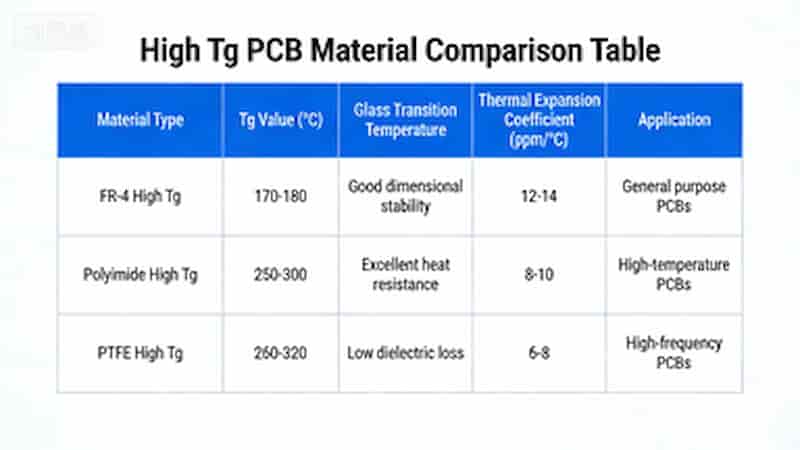
We use Tg 170–180+ FR‑4 materials for High Tg PCB production, lead‑free compatible for multiple reflow cycles.
| Material | Tg (℃) | Td (℃) | Layers | Application |
|---|---|---|---|---|
| High Tg FR‑4 Tg170 | 170+ | 330–340 | 4–12 | Industrial, LED, lead‑free assembly |
| ITEQ IT‑180A | 180 | 340–350 | 6–20 | Automotive, telecom, power |
| Ultra‑High Tg FR‑4 | 180–250 | 340+ | 8–30 | Aerospace, defense, high‑reliability |
Our High Tg PCB Manufacturing Capabilities
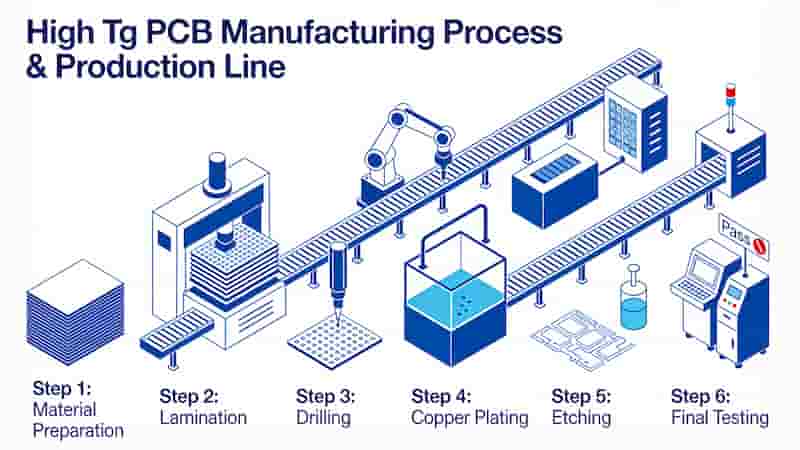
We deliver multilayer and HDI High Tg PCB with controlled CTE and low warpage for high‑reliability designs. Optimized processes include lamination, drilling, desmear, and thermal stress testing.
- Board types: High Tg PCB multilayer, HDI, mixed dielectric
- Layers: 2–20 layers (higher on request)
- Max panel size: 510 mm × 610 mm
- Thickness: 0.6–3.2 mm
- Copper weight: 0.5–3 oz inner / 1–3 oz outer
- Min trace/space: 4/4 mil (0.10/0.10 mm)
- Surface finishes: ENIG, Immersion Tin/Silver, OSP, Lead‑free HASL, Hard Gold
- Testing: 100% electrical test, AOI, impedance control, thermal reliability test
Design Guidelines for High Tg PCB
Follow these rules to maximize reliability of your High Tg PCB:
Material Selection
Maintain 20–30 ℃ safety margin between max operating temperature and Tg. For 140 ℃ operation, use Tg ≥170 ℃.
Stack-Up and Layout
Balance copper distribution to reduce warpage; use proper annular rings and via aspect ratios; add thermal vias for high‑power devices; optimize Dk/Df for high‑speed signals.
We provide fast engineering review and quotations for prototypes and small to medium volume production.
Request a High Tg PCB Quote
Upload your Gerber files and requirements to receive a High Tg PCB quotation and material recommendation within 24 hours.
Request High Tg PCB Quote
Get Your Reliable High Tg PCB Solution
We provide professional DFM review, material recommendation, and fast quoting for your high‑temperature projects.