Learn PCB DFM and DFA best practices to streamline manufacturing and assembly. This guide covers key design tips, common mistakes, and practical solutions for high-quality PCBs.
Why PCB DFM and DFA Matter
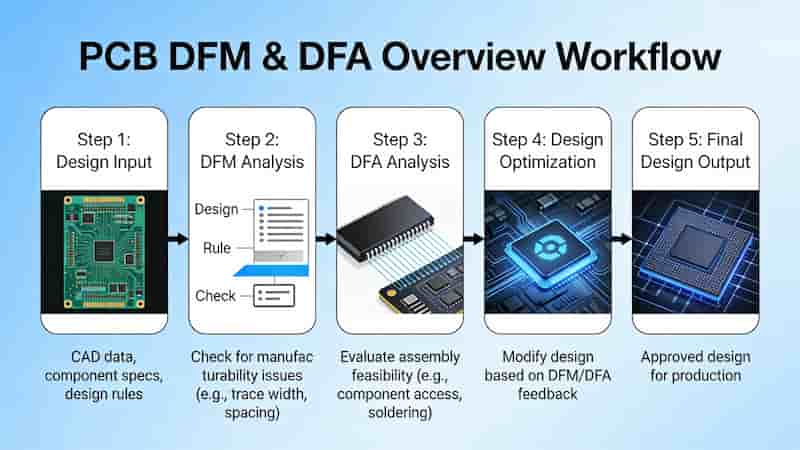
Creating a high-quality printed circuit board starts with smart design. PCB Design for Manufacturability (DFM) and Design for Assembly (DFA) are critical to ensuring your PCB is cost-effective, reliable, and easy to produce.
DFM focuses on aligning your design with manufacturing capabilities, while DFA simplifies component placement and soldering for efficient assembly. Poor design choices, such as incorrect via sizes or crowded layouts, can lead to defects, production delays, and higher costs.
This guide explores key PCB DFM and DFA considerations, common mistakes to avoid, and practical tips to optimize your design. Whether you are working on rigid, flexible, or high-density interconnect (HDI) PCBs, these best practices will help you achieve superior results.
What is PCB Design for Manufacturability (DFM)?
PCB DFM ensures your design is compatible with manufacturing processes, reducing defects and costs while speeding up production. It involves tailoring the PCB’s physical and electrical properties—such as board size, via dimensions, and trace widths—to the capabilities of modern manufacturing equipment.
For example, a design with 0.1mm trace widths may be unfeasible for some manufacturers, leading to etching failures. DFM also considers testing, rework, and repair feasibility to ensure long-term reliability.
Key DFM goals include:
- Minimizing manufacturing defects, such as incomplete vias or solder bridges.
- Shortening production cycles by simplifying fabrication processes.
- Reducing costs through optimized material use and process efficiency.
A real-world example: A multilayer PCB design with improper via spacing required 15% more rework time, increasing costs. By optimizing via placement, the manufacturer achieved a defect-free board in one cycle.
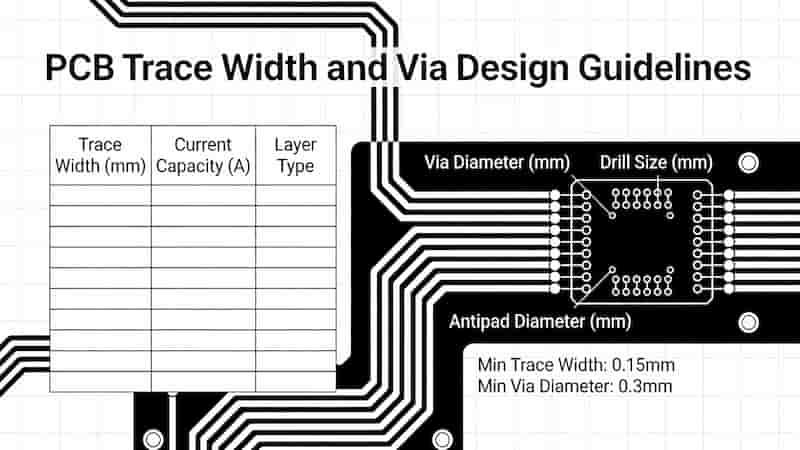
Key PCB DFM Considerations for Optimal Manufacturing
To achieve a manufacturable PCB design, consider the following factors, tailored to your board type (rigid, flexible, or HDI) and manufacturer capabilities.
PCB Size and Accuracy
Board dimensions must align with equipment limits. Most manufacturers support sizes up to 500mm x 500mm, with dimensional tolerances of ±0.1mm. Include process edges (5-10mm) for handling during fabrication. Oversized boards or tight tolerances may require specialized equipment, increasing costs.
Substrate Selection
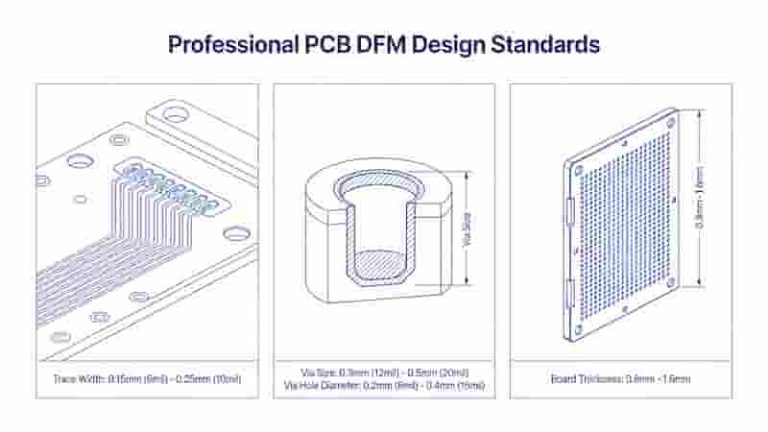
Choose standard substrates like FR-4 for rigid PCBs or polyimide for flexible PCBs to ensure compatibility. Non-standard materials may limit manufacturer options or increase lead times. Verify substrate thickness (e.g., 0.8mm–1.6mm for rigid boards) meets electrical and mechanical requirements.
PCB Structure and Thickness
Multilayer PCBs, common in complex designs, face layer-count and thickness constraints. For example, a 12-layer board with a 2mm total thickness may challenge some manufacturers’ lamination capabilities. Consult your manufacturer to confirm maximum layers and dielectric thickness.
Thickness-to-Via Ratio
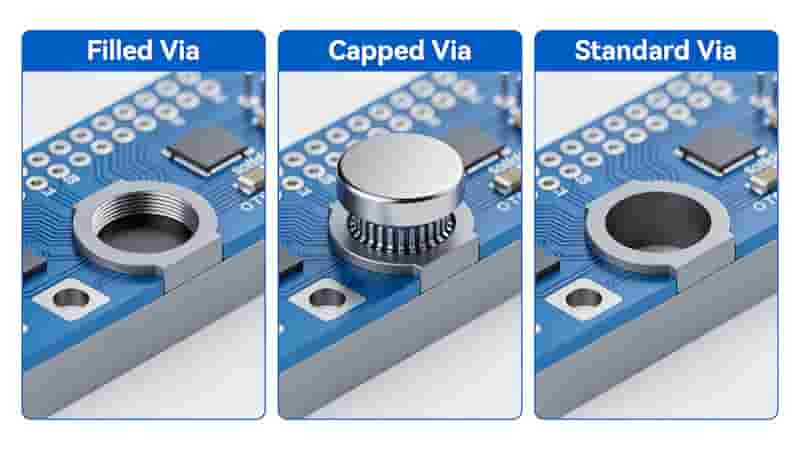
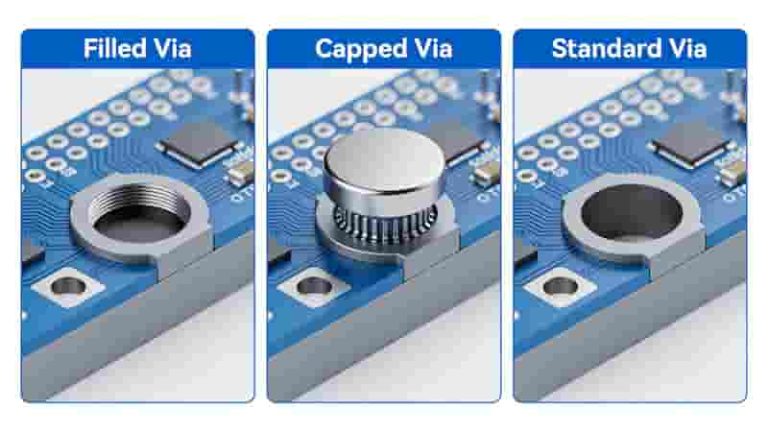
The ratio of board thickness to via diameter impacts hole metallization reliability. A ratio of 8:1 (e.g., 1.6mm board with 0.2mm vias) is ideal for most processes. Higher ratios increase plating complexity, risking incomplete metallization.
Minimum Hole Diameter and Spacing
Vias smaller than 0.3mm or spaced less than 0.5mm may exceed standard drilling capabilities. For HDI PCBs, 0.1mm vias are possible with advanced equipment, but confirm with your manufacturer to avoid fabrication issues.
Land Pattern and Trace Design
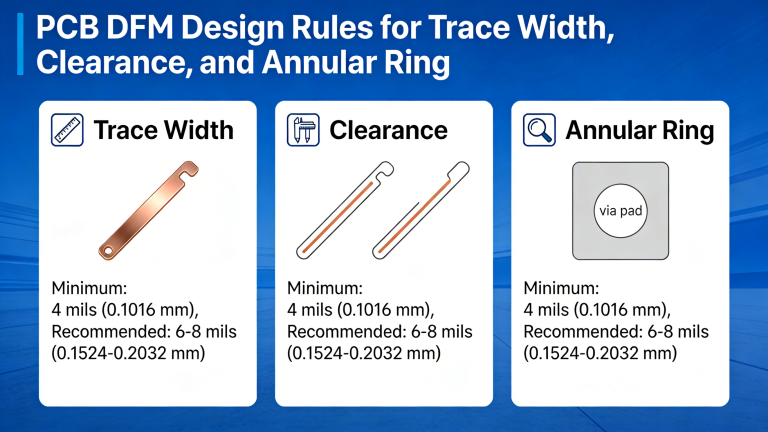
Trace widths and spacing affect etching accuracy and electrical performance. A minimum trace width of 0.1mm and spacing of 0.1mm are common for standard PCBs, while HDI designs may require 0.05mm. Ensure pads are sized for reliable soldering (e.g., 1.5mm² for through-hole components).
Special Considerations
Flexible PCBs require wider bend radii to prevent cracking, while HDI PCBs demand precise microvia alignment. These designs need tailored DFM rules to ensure manufacturability.
What is PCB Design for Assembly (DFA)?
PCB DFA focuses on simplifying component placement, soldering, and testing to streamline assembly and reduce errors. It ensures the PCB layout supports efficient installation, reliable connections, and easy maintenance.
For example, a crowded layout can cause soldering defects, while poor test point placement complicates quality checks. DFA is critical for through-hole, surface-mount, or chip-on-board assemblies, each with unique requirements.
Key DFA goals include:
- Simplifying component installation to reduce assembly time.
- Ensuring reliable soldering to prevent defects like bridges or cold joints.
- Facilitating testing and repair for long-term reliability.
A case study: A surface-mount PCB with insufficient pad spacing caused 10% of boards to fail due to solder bridges. Redesigning with wider spacing improved yield to 99%.
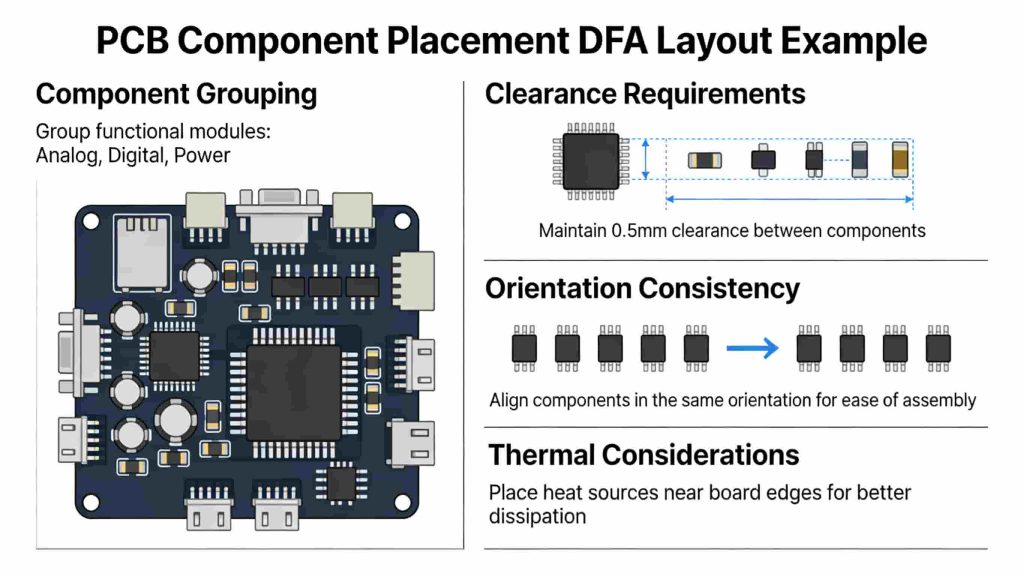
Key PCB DFA Considerations for Efficient Assembly
Optimize your PCB layout for assembly with these best practices, tailored to your soldering method and component types.
Component Layout and Spacing
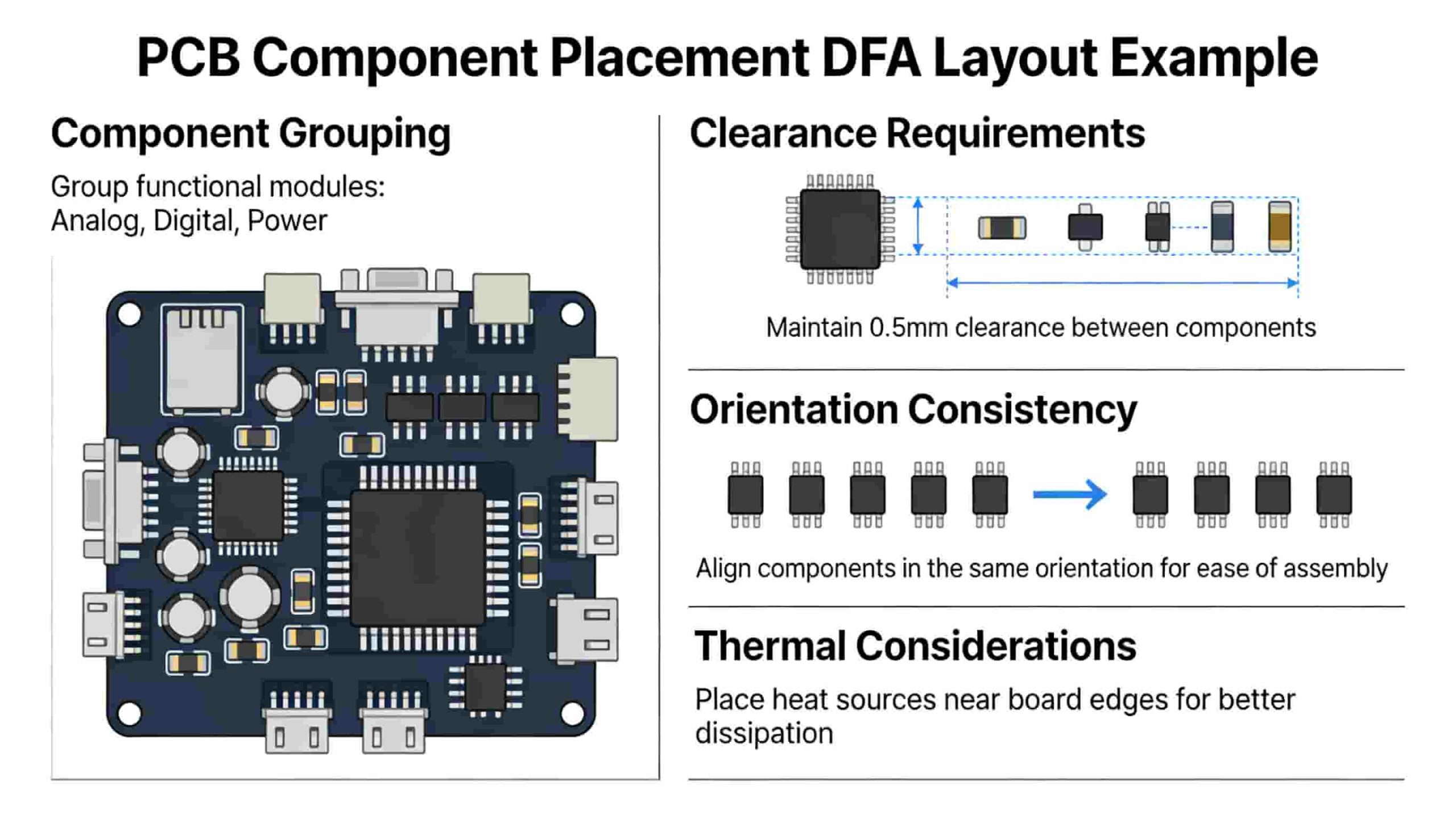
Ensure components are spaced at least 1mm apart for manual assembly or 0.5mm for automated processes. Keep components 5mm from board edges to allow handling and testing. Crowded layouts increase the risk of soldering defects and complicate repairs.
Pad and Hole Design
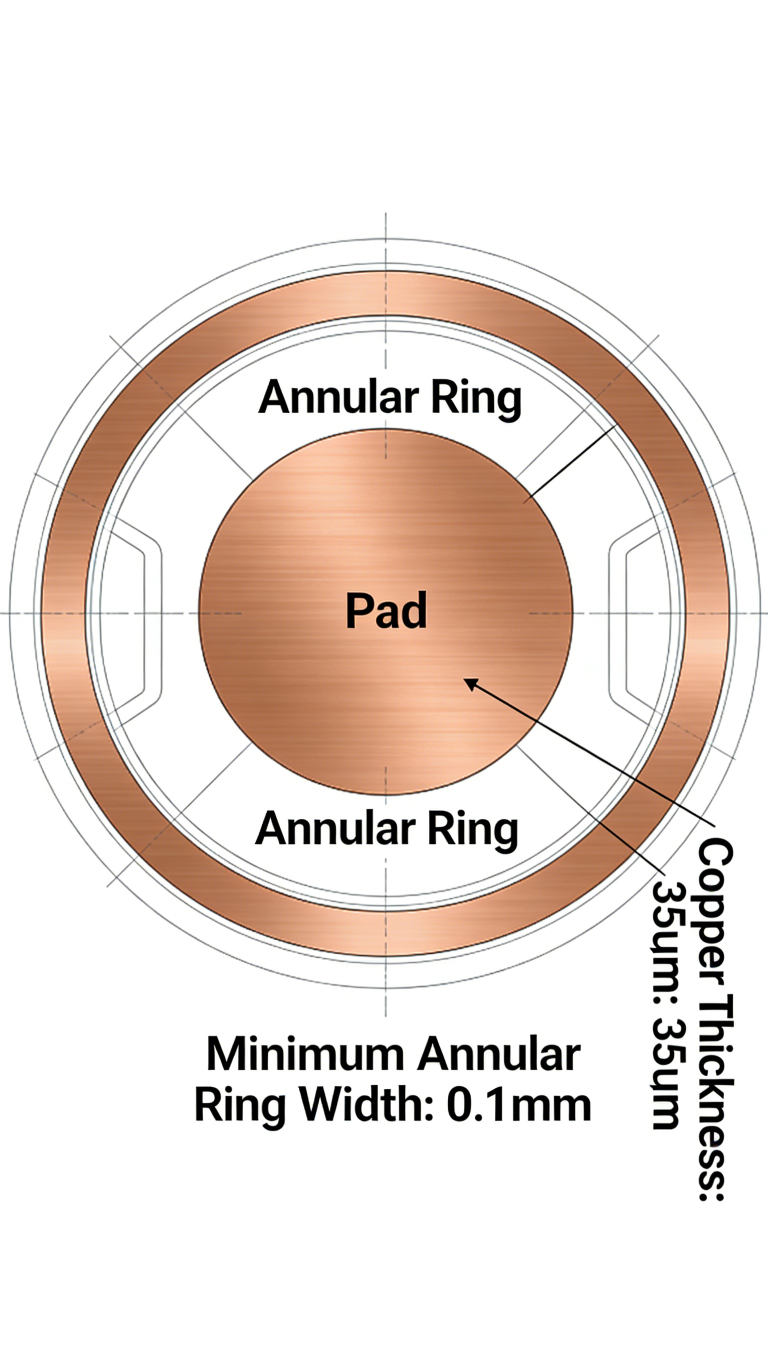
Pads must be sized for reliable soldering (e.g., 1.0mm² for surface-mount, 2.0mm² for through-hole). Ensure vias have a minimum annular ring of 0.15mm to prevent solder leakage. Misaligned pads can cause component shifting during reflow.
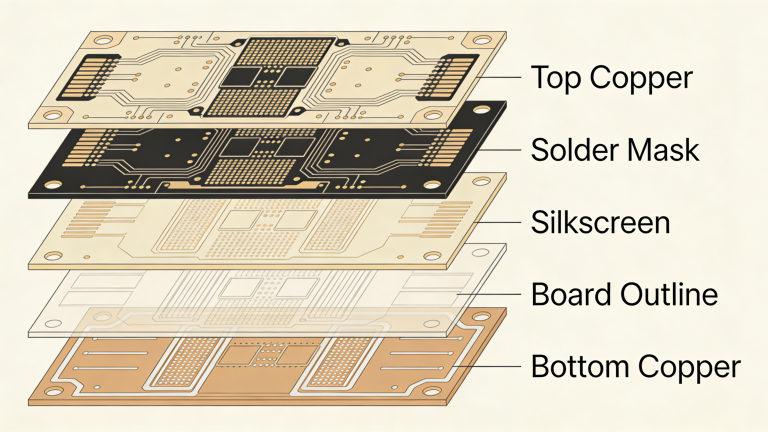
Solder Mask and Welding Methods
Use a solder mask for wave or reflow soldering to prevent bridges. For manual soldering, a mask is optional but recommended for precision. Reflow soldering requires a stencil for solder paste application, so design pads for stencil compatibility.
Thermal Management
Position heat-generating components (e.g., power ICs) with adequate spacing or near heat sinks. Orient components to align with airflow for efficient cooling. Poor thermal design can reduce component lifespan.
Test Points and Polarity Marks
Place test points on board edges or accessible areas, avoiding coverage by large components. Include clear polarity marks to prevent installation errors. Screen-printed marks must comply with printing tolerances (e.g., 0.2mm line width).
Electromagnetic Compatibility (EMC)
Minimize trace lengths and avoid parallel high-speed signals to reduce EMI. Group sensitive components away from noisy ones to ensure signal integrity.
Common PCB Design Mistakes to Avoid
Avoid these pitfalls to ensure a manufacturable and assemblable PCB:
- Ignoring Manufacturer Capabilities: Designing 0.05mm traces without confirming equipment limits can lead to production failures.
- Inadequate Spacing: Crowded component layouts cause soldering defects or testing issues.
- Poor Via Design: Vias smaller than 0.2mm or with high thickness-to-diameter ratios risk incomplete metallization.
- Missing Solder Masks: Omitting masks in wave soldering increases short-circuit risks.
- Neglecting EMC: Poor trace routing can cause signal interference, affecting performance.
Tip: Always consult your manufacturer’s DFM/DFA guidelines before finalizing your design.

Conclusion
Optimizing your PCB design for manufacturability (DFM) and assembly (DFA) is essential for reducing costs, improving quality, and accelerating production. By following the best practices outlined in this guide—such as optimizing trace widths, spacing components correctly, and using solder masks—you can avoid common design pitfalls and achieve reliable, high-performance PCBs.
We specialize in PCB manufacturing and assembly, ensuring your designs meet the highest standards. Our expert team provides full DFM/DFA analysis to support your global projects.
Get Professional PCB DFM & DFA Support
Send your Gerber files, BOM, and project requirements for a free DFM/DFA review and custom quotation. We deliver high-quality PCBs with fast lead times for global buyers.
Contact Us for a Free Quote

PCB Fabrication Process Flow Chart: Complete Step-by-Step Industrial Guide

Understanding Plated Through Holes (PTH) for Printed Circuit Boards

How to Judge PCB Quality: 7 Expert Tips for Reliable Boards
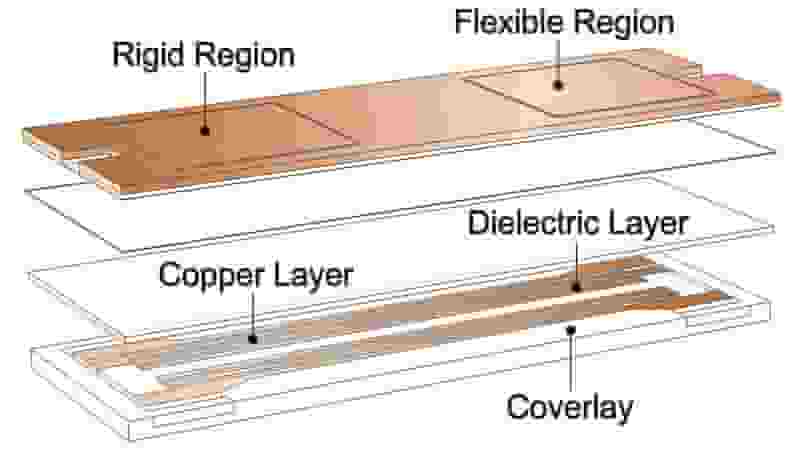
Rigid-Flex PCB Stackup: Design and Manufacturing Guide
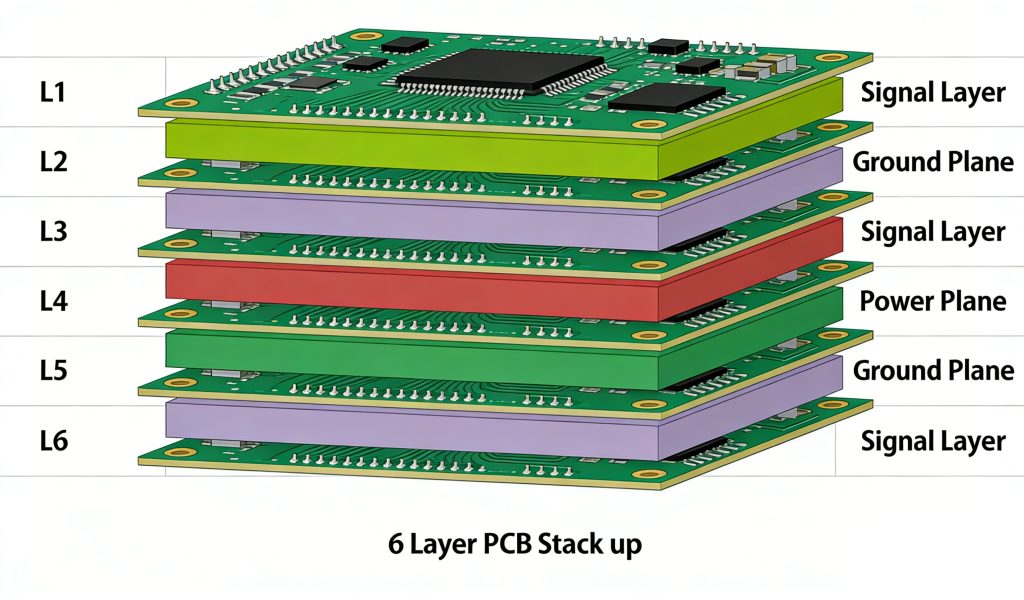
6 Layer PCB Guide: Stackup, Thickness, Design & Competitive Price