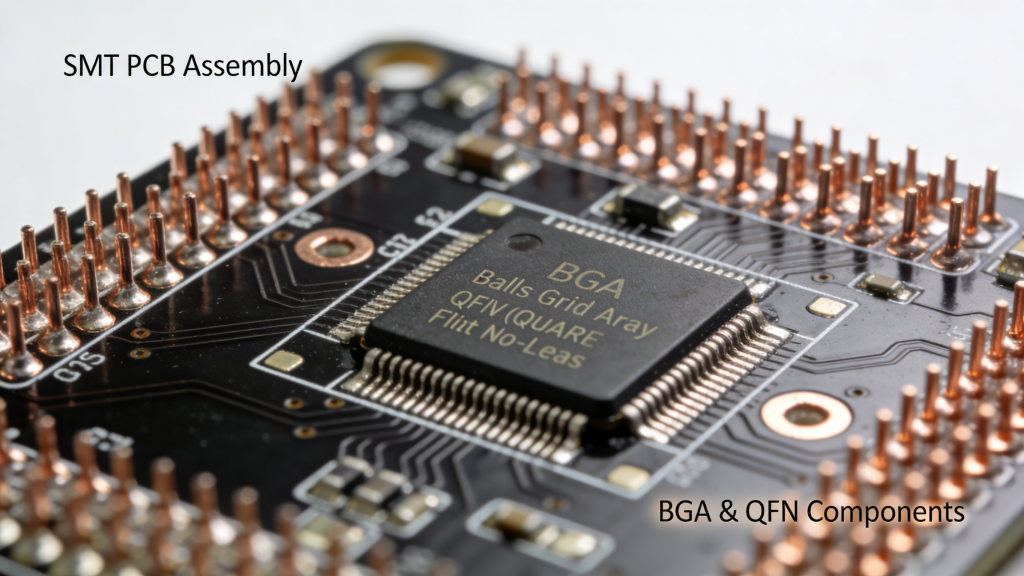
This professional guide covers the top 30 SMT PCB assembly defects, their root causes, quality risks, and proven fixes to boost yield and reliability for industrial buyers and engineers.
1. Soldering & Solder Joint Defects
Solder joints are the foundation of reliable SMT PCB assembly. Even minor flaws cause intermittent failures or early breakdowns.
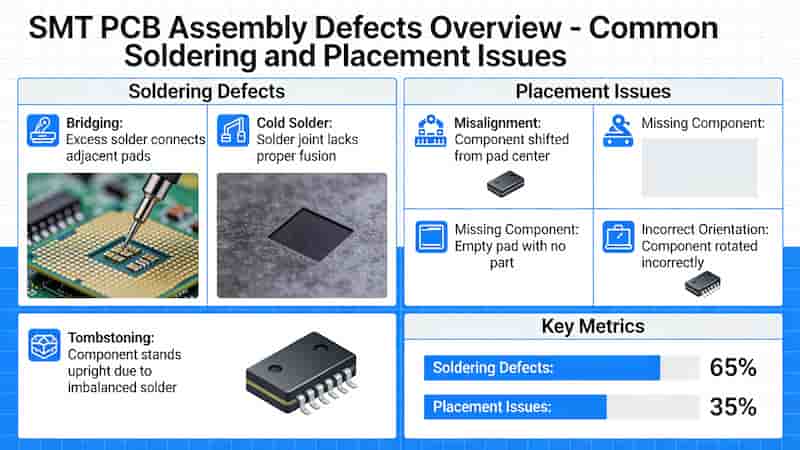
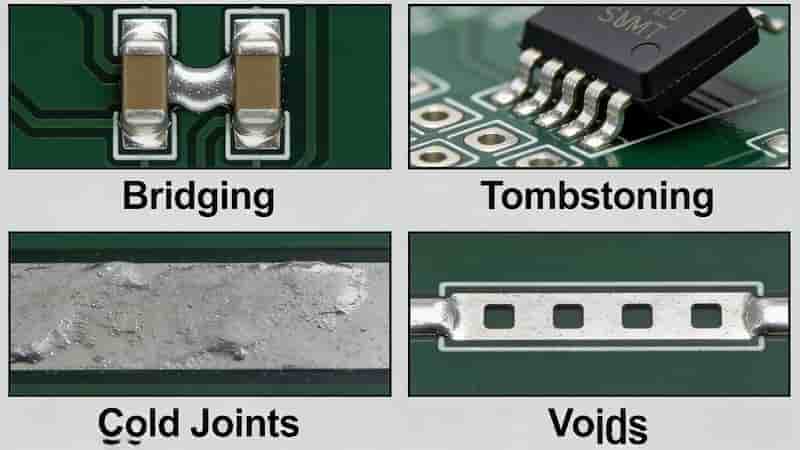
1. Solder Bridging – Unintended solder connects adjacent pads, causing short circuits. Caused by excess paste, poor stencil design, or fine pitch misalignment.
2. Tombstoning (Manhattan Effect) – One end of a chip component lifts during reflow due to uneven heating or asymmetric pads.
3. Cold Solder Joint – Dull, grainy joint with incomplete metallurgical bonding from insufficient reflow heat or oxidation.
4. Insufficient Solder / Open Joint – Too little paste forms weak or open connections, often from clogged stencils or poor printing.
5. Excess Solder – Too much solder creates bulky joints, risking shorts and thermal issues.
6. Solder Balls / Beading – Small solder spheres from flux outgassing or paste spatter during reflow.
7. Solder Voids – Gas pockets inside joints weaken strength and thermal performance, detected by X-ray.
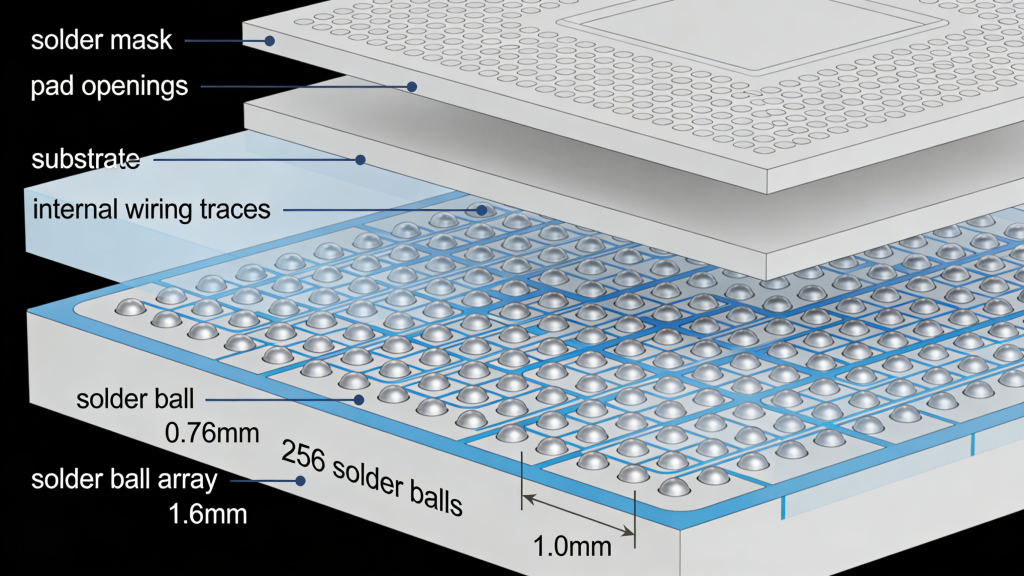
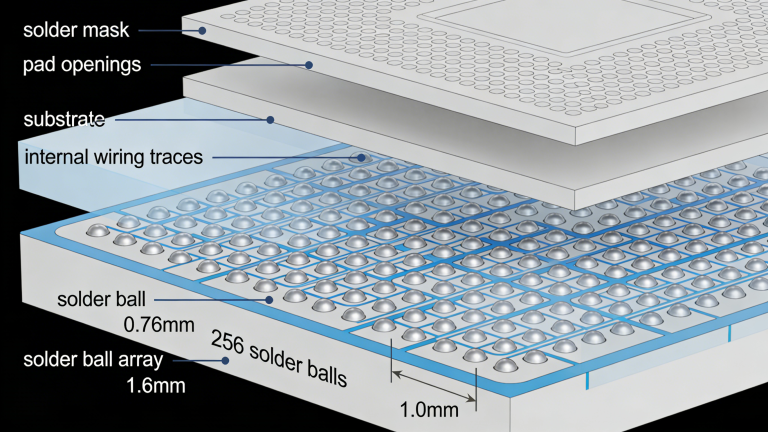
8. Head-in-Pillow (HiP) – BGA defect where solder ball and pad paste fail to merge, caused by warpage or oxidation.
9. Non-Wetting / De-Wetting – Solder fails to adhere to pads or leads due to contamination or weak flux.
10. Lifted Leads – Component leads pull away from pads during cooling due to thermal stress.
2. Component Placement Defects
Precision placement ensures stable PCB assembly; misalignment leads to functional failures and rework.
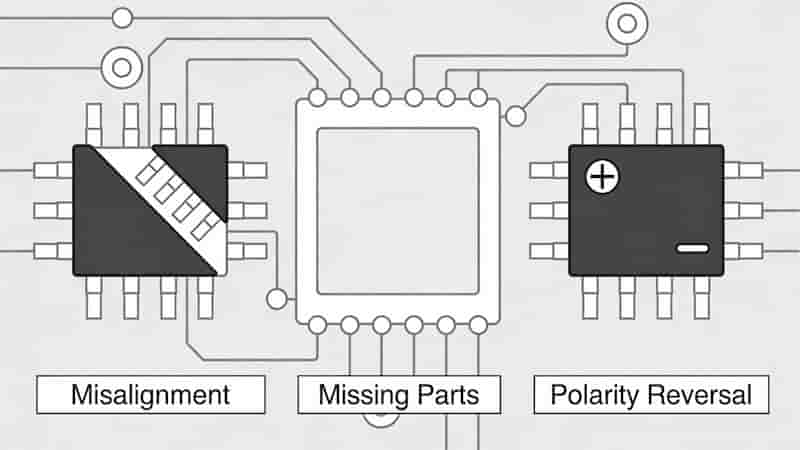
11. Component Misalignment – Parts offset from pads, causing poor wetting or tombstoning.
12. Component Shift – Parts move after placement due to vibration or unstable paste tack.
13. Missing Components – Empty pads from pick-and-place failure or feeder errors.
14. Polarity Reversal – Diodes, capacitors, or ICs installed backward, leading to functional failure.
15. Wrong Components – Incorrect part type or value mounted due to feeder mix-up.
16. Component Damage – Cracked chips, bent leads, or internal damage from excessive placement force.
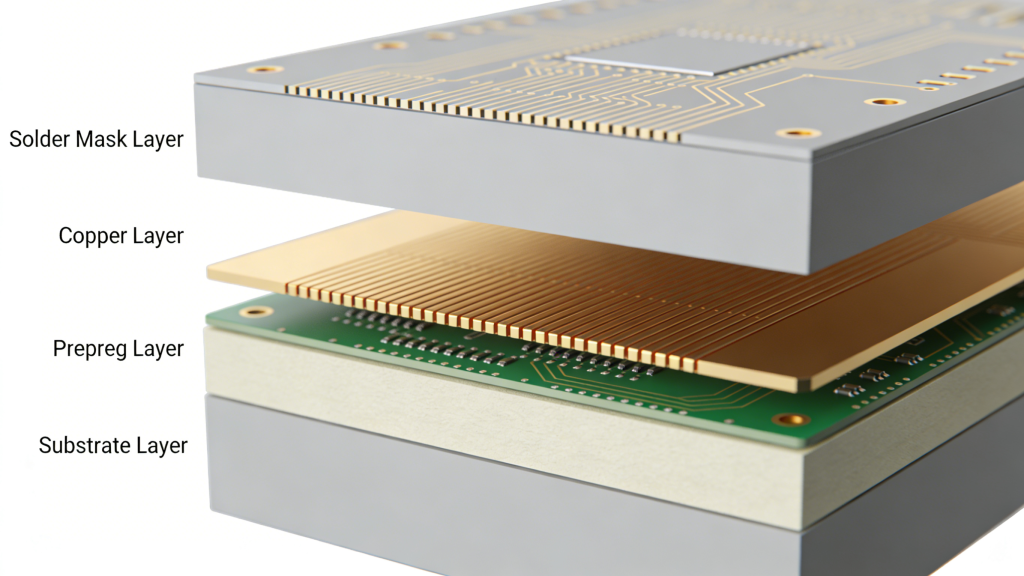
Board and material flaws undermine the structural integrity of SMT PCB assembly and long-term reliability.
19. Board Warpage – PCB bending during reflow causes uneven soldering and joint stress.
20. Solder Mask Defects – Insufficient, excess, or peeling solder mask leading to exposed copper or shorts.
21. Delamination – Layer separation in the PCB due to heat, moisture, or poor lamination.
22. Pad Damage / Lift – Copper pads peel off the substrate during rework or thermal stress.
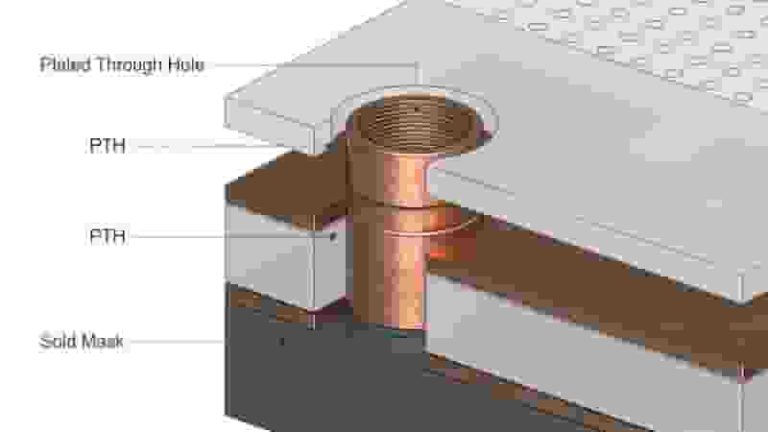
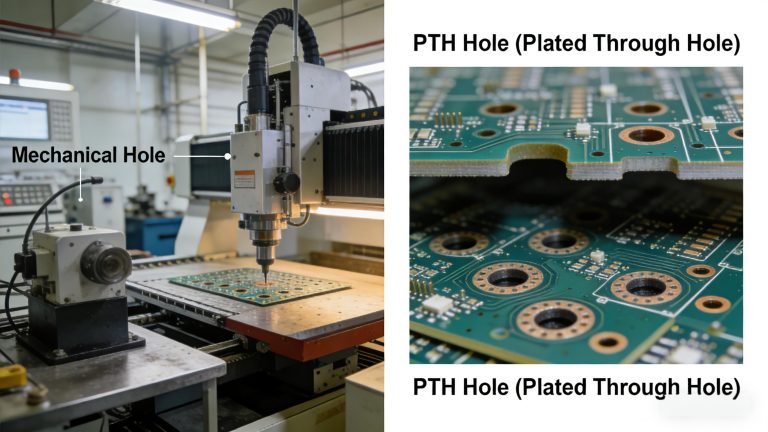
23. Hole Damage / Deformation – Via or mounting hole distortion affecting assembly and connectivity.
4. Process & Inspection Defects
Process and inspection gaps allow defects to escape, harming yield and product trust.
24. Insufficient Cleaning – Flux residue or contamination causing corrosion or electrical leakage.
25. Incomplete Inspection – Missed defects in visual, AOI, or X-ray checks.
26. Rework Damage – Board or component harm from improper desoldering or rework.
27. Contamination – Dust, oil, or moisture degrading solder wetting and insulation.
28. Improper Storage – Moisture absorption in PCBs or components leading to popcorning.
29. Profile Deviation – Incorrect reflow temperature or timing causing consistent joint flaws.
30. Functional Test Failure – Assembled board fails electrical test despite passing visual checks.
5. Defect Comparison & Quick Solutions
Defect Type
Main Cause
Quick Fix
Solder Bridging
Excess paste, poor stencil
Optimize stencil aperture, reduce paste
Tombstoning
Uneven heating, asymmetric pads
Symmetric pads, balanced reflow
Cold Solder
Insufficient reflow heat
Adjust thermal profile
Component Misalignment
Placement calibration error
Recalibrate pick-and-place
Solder Voids
Trapped flux volatiles
Improve soak stage, high-quality paste
6. Summary & Next Steps
Understanding these 30 SMT PCB assembly defects helps engineers and buyers reduce failures, improve yield, and ensure compliance with IPC-A-610 standards. Stable, low-defect PCB assembly directly lowers costs and boosts product reliability.
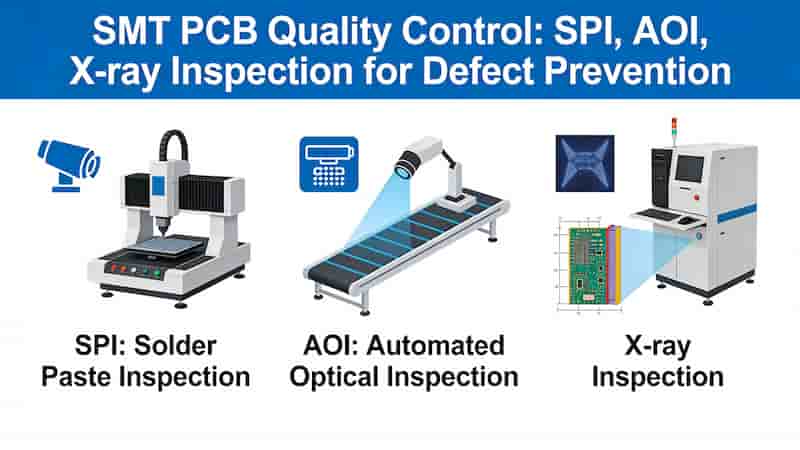
We specialize in high-quality, defect-controlled SMT PCB assembly for industrial, medical, automotive, and consumer electronics. Our process includes strict DFM review, SPI/AOI/X-ray inspection, and IPC-standard process control to minimize defects and maximize yield.
Need Reliable SMT PCB Assembly?
Request a free quote, DFM analysis, or custom solution for your project.
FR-4 is the global industry-standard flame-retardant glass-reinforced epoxy laminate for rigid PCB fabrication. This guide explains definition, composition, properties, grades, selection, and why FR-4 PCB is the top choice for engineers and global buyers. What is FR-4 Material? FR-4 (Flame Retardant Type 4) is a NEMA-defined material grade for flame-resistant epoxy laminates. It is not…
FR-4 is the global industry-standard flame-retardant glass-reinforced epoxy laminate for rigid printed circuit boards. Defined by NEMA LI-1 and IPC-4101, it delivers balanced electrical insulation, mechanical strength, thermal stability, UL94 V-0 flame resistance, and cost efficiency for industrial, automotive, telecom, and consumer electronics. What is FR-4 Material? FR-4 (Flame Retardant Type 4) is a material…
A Surface Mount Device (SMD) component package is a standardized enclosure designed for direct soldering onto PCB surfaces, enabling high-density assembly, miniaturization, and automated manufacturing in modern electronics. What Is an SMD Component Package? SMD stands for Surface Mount Device, referring to electronic components designed exclusively for Surface Mount Technology (SMT) assembly. An SMD component…
We provide end-to-end turnkey PCB assembly supporting full and partial models, with SMT assembly, THT, BGA/QFN, rigorous testing, and global logistics for industrial buyers, engineers, and importers. What Is Turnkey PCB Assembly Turnkey PCB assembly is a one-stop manufacturing solution covering PCB fabrication, component sourcing, assembly, testing, and delivery. We manage the full supply chain…
We provide reliable through-hole PCBAs assembly service for industrial, power, medical, aerospace and automotive applications. Our IPC-standard THT assembly supports prototypes to mass production with wave soldering, selective soldering and full inspection. Through-hole PCB Assembly Service Overview Our through-hole PCB assembly fulfills leaded assembly demands across industries. We deliver single-sided, double-sided and high-density multilayer through-hole…
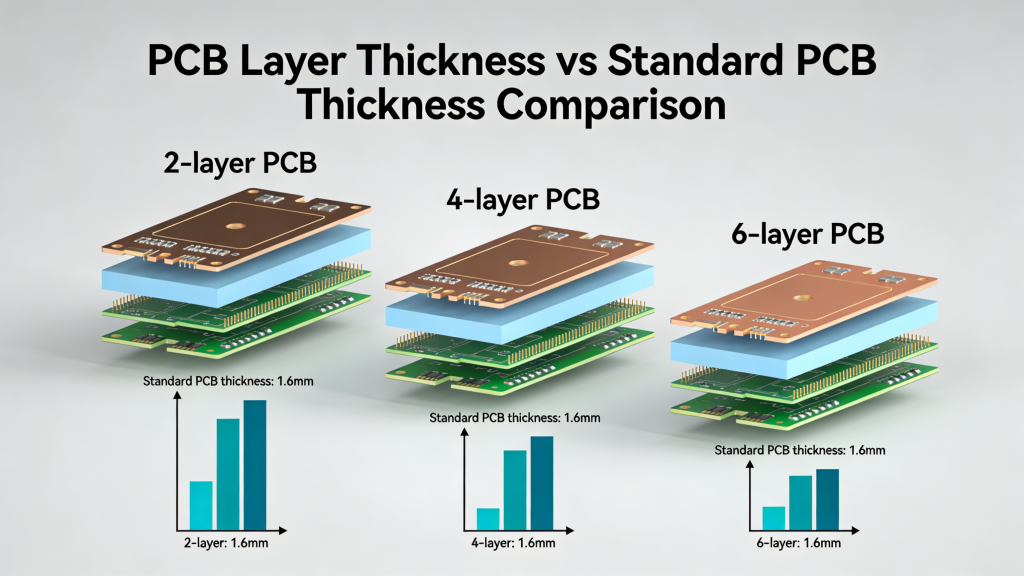
Standard PCB thickness is critical for mechanical strength, signal integrity, and assembly compatibility. This guide covers definitions, industry standards, influencing factors, manufacturing constraints, and design best practices for global industrial buyers. What Is Standard PCB Thickness The global standard PCB thickness is 1.57 mm (0.062 in), commonly referenced as 1.6 mm for simplicity. This is…
We provide professional SMT PCB assembly services supporting rapid prototypes to high-volume production. Certified to IPC‑A‑610 Class 2/3, ISO 9001, RoHS, we deliver precision assembly for 01005 components, fine‑pitch BGAs, rigid/flex/rigid‑flex PCBs with full inspection and global delivery. Core SMT PCB Assembly Capabilities We support full‑process SMT PCB assembly from prototype validation to stable mass…
We provide professional single layer PCB manufacturing and cost-effective single sided PCBs for LED lighting, power supplies, consumer electronics, and industrial equipment. Our ISO & IPC‑certified production ensures stable quality, fast lead times, and free DFM analysis for prototypes and mass production. Single-Layer PCB Definition A single layer PCB (also called single sided PCB) has…
We are a leading China-based Rigid-Flex PCB manufacturer specializing in 1–12 layer rigid-flex PCB prototype, small-to-large volume fabrication, and full assembly with fast turnaround, free DFM check, and ISO/UL/RoHS certification. Benefits of Rigid-Flex PCB Rigid-Flex PCB integrates the stability of rigid boards with the flexibility of flex circuits, delivering superior performance for compact, high‑reliability electronic…
Get reliable quick turn PCB assembly with one-stop PCB fabrication, components sourcing, SMT/THT assembly and testing, helping you turn ideas into working boards in days instead of weeks. What Is Quick Turn PCB Assembly Service? Quick turn PCB assembly is an accelerated manufacturing process that integrates PCB fabrication, component sourcing, SMT/THT assembly and testing to…
PCB Solder Mask (also known as solder resist) is a protective polymer layer applied to printed circuit boards to prevent solder bridging, resist oxidation, improve insulation, and ensure long‑term reliability in SMT assembly and industrial applications. This guide covers definitions, types, colors, processes, DFM rules, IPC standards, testing, and troubleshooting for engineering and procurement teams…
We provide high-quality, low-cost PCB prototypes and professional PCB assembly for global engineers and buyers. Reliable, fast, and cost-effective PCB solutions from 2-layer to multilayer, flexible, and rigid-flex boards. Why Choose Us for Low-Cost PCB Prototypes We balance affordable PCB prototypes with consistent, industrial-grade quality. Our advantages help you reduce costs while ensuring reliability: Factors…
We offer professional multilayer PCB manufacturing services in China supporting 4 to 30 layer rigid, flex, and rigid-flex PCBs. Our high-reliability boards serve industrial, telecom, medical, aerospace, and automotive applications with ISO 9001, IATF 16949, IPC-A-610 Class 3, UL, and RoHS compliance. Multilayer PCB Manufacturing Capabilities We provide comprehensive multilayer PCB manufacturing with precise specifications…
FR-4 is the most widely used flame-retardant glass-epoxy laminate material for rigid PCB manufacturing. Defined by NEMA standards, it offers excellent electrical insulation, mechanical strength, thermal stability, and cost efficiency, making it the global industry standard for most electronic applications. What is FR-4 Material? FR-4 (Flame Retardant Grade 4) is a NEMA-defined material grade for…
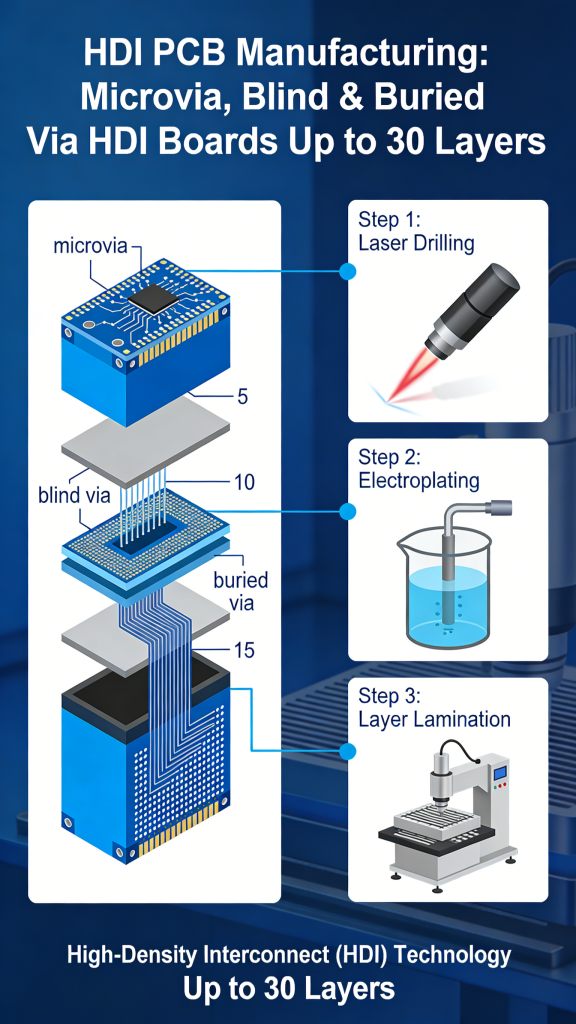
HDI PCB manufacturing provides high-density interconnect solutions with microvia, blind via, and buried via structures for compact, high-performance electronics. We deliver reliable HDI boards from prototype to mass production, supporting up to 30 layers for automotive, 5G, medical, and industrial applications. What Is HDI PCB and Why Choose It High-density interconnect (HDI) PCBs offer much…
We provide professional BGA PCB manufacturing, precision assembly, advanced rework, and full testing for high-reliability electronics. Our ISO/IPC-certified processes support prototypes to mass production for global industrial buyers, engineers, and procurement teams. What Is BGA (Ball Grid Array) and Why It Matters for Your PCB? A ball grid array (BGA) is a high-density surface-mount package…
Standard PCB thickness is typically 1.57 mm (0.062 inches), often rounded to 1.6 mm. This guide covers definitions, influencing factors, manufacturing constraints, non-standard design rules, and selection tips for industrial buyers and engineers. Quick Overview: standard PCB thickness (1.6mm) is industry default; common alternatives include 0.78mm (0.031in) and 2.36mm (0.093in). Thickness impacts durability, weight, assembly,…
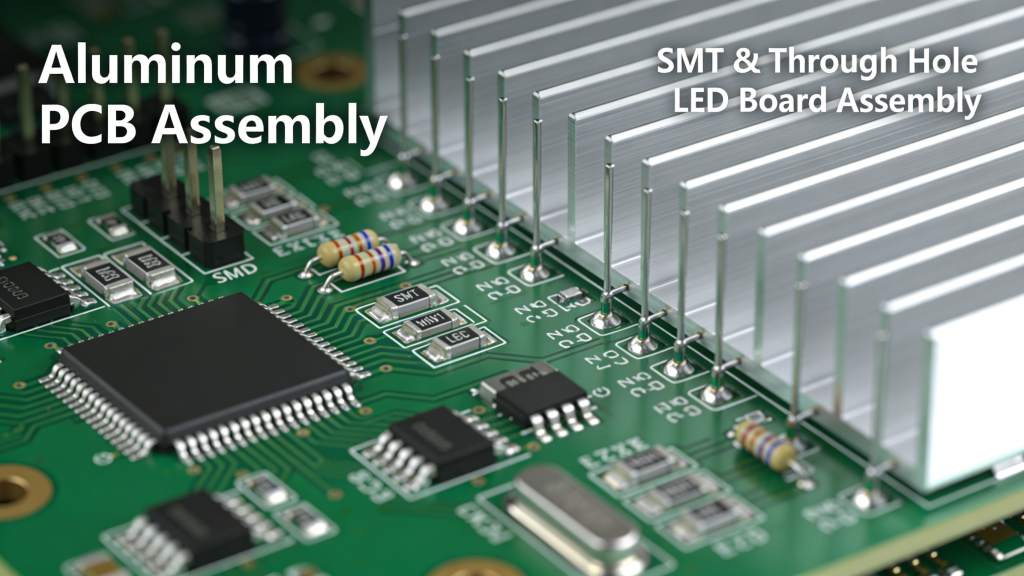
We are a trusted Aluminum PCB manufacturer and MCPCB supplier in China, delivering fast prototypes and small‑to‑medium volume production for LED lighting, power supplies, and high‑power electronics. Our in‑house lines ensure stable quality, controlled costs, and on‑time delivery for global buyers. Aluminum PCB Manufacturing Capabilities With 15+ years of expertise in Aluminum PCB and MCPCB…
Looking for a trusted PCB manufacturer in South Africa for prototypes, mass production, or full PCBA? We deliver high-quality, cost-effective PCB manufacturing and assembly solutions to industrial buyers, engineers, and procurement teams across South Africa. Local PCB Manufacturing in South Africa We are a professional local PCB manufacturer serving South Africa with flexible lead times…
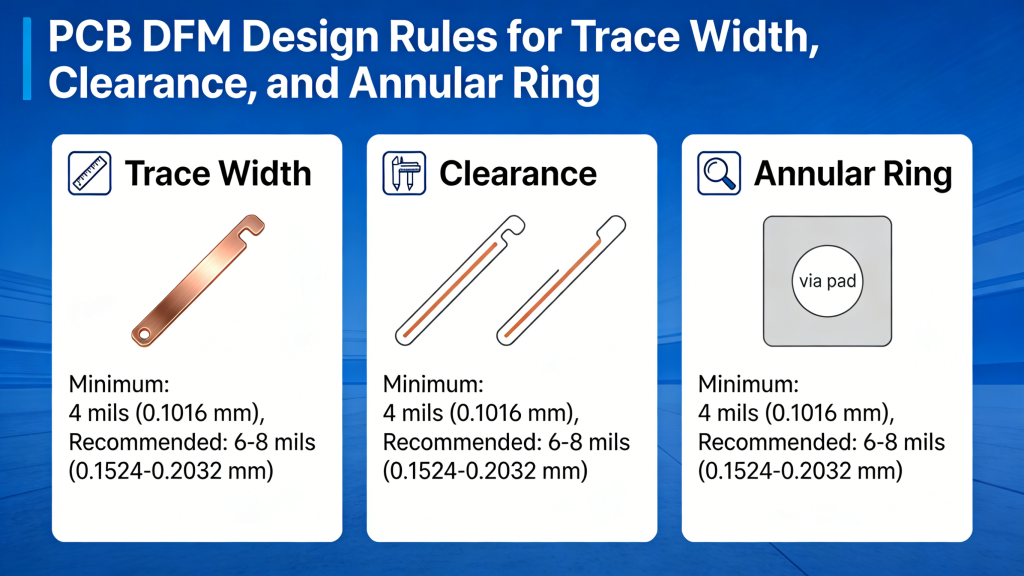
This professional guide covers PCB DFMA principles, IPC standards, manufacturability rules, assembly optimization, yield improvement, cost reduction, and global industrial best practices for reliable PCB and PCBA production. What is DFMA for PCB? DFMA (Design for Manufacturability and Assemblability) integrates DFM and DFA into a unified engineering framework to optimize PCB design for production efficiency,…
Flying Probe Testing for PCB is a fixtureless electrical testing method widely used for prototype, low-volume and high-mix printed circuit board production. It accurately detects opens, shorts, wrong components, reverse polarity and soldering defects without expensive custom fixtures, making it the top choice for engineering verification and small-batch manufacturing. What is Flying Probe Testing? Flying…
This guide details all essential PCB & PCBA manufacturing files, including Gerber files, BOM lists, NC Drill files, Centroid files, and other critical documents. It provides professional standards, format requirements, and technical parameters to ensure accurate quotes, error-free production, and reliable PCB assembly for global industrial buyers, engineers, and procurement teams. Core Files for PCB…
This guide covers everything about PCB solder mask (solder resist), including its functions, types, colors, application processes, thickness standards, IPC testing, and assembly compatibility. Learn how solder mask protects circuits, prevents solder bridging, and improves reliability for industrial and high-density PCBs. We explain how to select the right solder resist for rigid, flexible, and high-speed…
We specialize in LED PCB manufacturing and assembly with aluminum, copper & flexible substrates featuring superior heat dissipation. ISO 9001 certified, fast turnaround & competitive pricing for global LED lighting projects. Superior Heat Dissipation 1-9 W/mK thermal conductivity Fast Turnaround 24-hour quote, 3-5 days delivery ISO 9001 Certified International quality standard One-Stop PCBA Service From…
We deliver reliable SMT PCB Assembly for rapid prototypes, NPI, low-volume and high-volume production. Our full turnkey solutions support fine-pitch components, BGAs, QFNs, rigid/flex‑rigid PCBs, and comply with IPC Class 2 & Class 3 standards for global industrial buyers. SMT PCB Assembly Capabilities We support full‑cycle SMT PCB Assembly from single prototypes to mass production,…
We provide reliable through-hole PCBAs assembly service for industrial, power, medical, aerospace and automotive applications. Our IPC-standard THT assembly supports prototypes to mass production with wave soldering, selective soldering and full inspection. Through-hole PCB Assembly Service Overview Our through-hole PCB assembly fulfills leaded assembly demands across industries. We deliver single-sided, double-sided and high-density multilayer through-hole…
We provide professional single layer PCB manufacturing and cost-effective single sided PCBs for LED lighting, power supplies, consumer electronics, and industrial equipment. Our ISO & IPC‑certified production ensures stable quality, fast lead times, and free DFM analysis for prototypes and mass production. Single-Layer PCB Definition A single layer PCB (also called single sided PCB) has…
PCB Solder Mask (also known as solder resist) is a protective polymer layer applied to printed circuit boards to prevent solder bridging, resist oxidation, improve insulation, and ensure long‑term reliability in SMT assembly and industrial applications. This guide covers definitions, types, colors, processes, DFM rules, IPC standards, testing, and troubleshooting for engineering and procurement teams…
We provide professional Double Sided PCB manufacturer in China for global industrial buyers, engineers, and procurement teams. Our full capabilities cover prototyping, mass production, DFM, assembly, and strict quality control to meet IPC standards for reliable, high-performance double-layer PCBs. Why Choose Us for Double Sided PCB Manufacturing We are a professional manufacturer focused on Double…
Get a clear quote within 24 hours and receive high-quality PCB prototypes in as fast as 3-5 days, with one-to-one engineering support from inquiry to delivery. Get a Free Quote Now 24h quotation · 3-5 day PCB prototyping · One-stop PCB & PCBA Why Engineers and Buyers Choose Us From fast PCB prototypes to full…
A Surface Mount Device (SMD) component package is a standardized enclosure designed for direct soldering onto PCB surfaces, enabling high-density assembly, miniaturization, and automated manufacturing in modern electronics. What Is an SMD Component Package? SMD stands for Surface Mount Device, referring to electronic components designed exclusively for Surface Mount Technology (SMT) assembly. An SMD component…
We provide professional BGA PCB manufacturing, precision assembly, rework, reballing, and full turnkey solutions for global industrial, automotive, medical, and telecom customers. Our ISO & IPC-compliant processes ensure high yield, reliability, and fast delivery from prototypes to volume production. What Is BGA (Ball Grid Array) and Why It Matters for Your PCB? A ball grid…
We are a professional PCB manufacturer in South Africa delivering reliable local PCB manufacturing, prototype, assembly and custom PCB services with high quality and fast delivery. Local PCB Manufacturing in South Africa As a trusted local PCB manufacturer, we provide complete PCB manufacturing in South Africa with cost-effective solutions for industrial, automotive, telecom and medical…
Optimize your PCB design for high yield, low cost, and reliable assembly with industry-leading DFM and DFA principles aligned with IPC standards. What is Design for Manufacturing Design for Manufacturing, also known as concurrent or simultaneous engineering, focuses on the relationship between product physical design and manufacturing systems. By integrating DFM principles into product design,…
We are a professional Metal Core PCB manufacturer in China, providing fast MCPCB prototypes and small-batch production with aluminum and copper cores at competitive prices for LED and power electronics. Why Metal Core PCBs (MCPCBs) for High-Power Designs High-power electronic designs face critical thermal management challenges that traditional FR4 PCBs cannot adequately address. Metal Core…
Standard PCB thickness is critical for mechanical strength, signal integrity, and assembly compatibility. This guide covers definitions, industry standards, influencing factors, manufacturing constraints, and design best practices for global industrial buyers. What Is Standard PCB Thickness The global standard PCB thickness is 1.57 mm (0.062 in), commonly referenced as 1.6 mm for simplicity. This is…
PCBs For New Energy Applications – The Top PCB Partner for Innovations in Energy and Renewable Technologies Abstract As global demand for renewable energy grows, PCBs For New Energy Applications have become critical components in solar, wind, energy storage, EV, and fuel cell systems. We specialize in manufacturing high-performance, durable printed circuit boards engineered to…
Discover industry-leading performance with our nano-coated PCB stencils. Engineered to support high-precision SMT printing processes, professional nano surface treatment greatly improves stencil durability, stabilizes solder paste deposition quality, and cuts routine maintenance workload, helping your entire PCB assembly line run stably and efficiently. Why Choose Nano-Coated PCB Stencils For SMT Production Nano-coated SMT stencils deliver…
We provide high-quality, low-cost PCB fabrication and PCB assembly for engineers, procurement teams, and global buyers. From 2-layer to multilayer and flexible PCBs, we deliver fast, reliable solutions tailored to your project requirements. Why Choose Us for Low-Cost PCB Prototypes We combine affordable PCB prototypes with consistent quality and professional support. As a reliable manufacturer,…
Bill of Materials (BOM) is the foundational document for PCB assembly and PCBA manufacturing. It lists all components, quantities, specifications, and reference details to ensure accurate sourcing, smooth production, and error-free assembly. This professional guide helps industrial buyers, engineers, and procurement teams create a complete, standardized PCB BOM for reliable prototyping and mass production. What…
With over 14 years of expertise, we deliver cost‑effective, scalable High Volume PCB Assembly Services for automotive and medical industries. Our advanced automation and rigorous quality control ensure reliable PCBAs with fast global delivery. What is High Volume PCB Assembly? High volume PCB assembly refers to large‑scale production of printed circuit boards built to serve…
Low-volume or small-batch PCB assembly is your best solution for flexible assembly parts on a relatively small batch of bare PCB boards! A low-cost PCB prototype is essential if you are looking at a new launch. After all, you do not want a situation where you deal with errors after a high-volume or mass production run. Alternatively, you could be…
Copper Clad Laminate (CCL) is the material on which all circuitry and printed circuit boards (PCBs) are based. It is the basic material used in the PCB industry with wide applications in consumer electronics (e.g. radio and television), mobile communication industry, computers, avionics, military hardware, and others. The copper-clad laminate manufacturing industry is a growing industry with…
We provide professional SMT PCB assembly supporting rapid prototypes to high-volume production, compliant with IPC-A-610, ISO, and RoHS standards, with full inspection, fast lead times, and global delivery for industrial buyers and engineers. SMT PCB Assembly Capabilities Our SMT PCB assembly supports single-sided, double-sided, and mixed-tech assembly for rigid, flex, and rigid-flex PCBs. We handle…
FR-4 is the most widely used flame-retardant glass-epoxy laminate material for rigid PCB manufacturing. Defined by NEMA standards, it offers excellent electrical insulation, mechanical strength, thermal stability, and cost efficiency, making it the global industry standard for most electronic applications. What is FR-4 Material? FR-4 (Flame Retardant Grade 4) is a NEMA-defined material grade for…
FAQs About Common SMT PCB Assembly Defects
A: Common issues include solder bridging, tombstoning, cold joints, insufficient solder, solder voids, non-wetting and head-in-pillow for BGA components.
A: It mainly results from uneven heating across component ends or asymmetric pad design on the PCB.
A: Optimize stencil aperture size and shape, control solder paste volume and ensure accurate component placement.
A: Misalignment comes from pick-and-place calibration errors. Component shift is usually caused by weak solder paste tack or equipment vibration.
A: Warpage happens under high reflow temperature. It causes uneven soldering, joint stress and poor contact for SMT parts.
A: Excessive thermal stress, improper rework operation and poor PCB material quality are the main causes of pad lifting.
A: Residual flux leads to circuit corrosion, electrical leakage and reduced long-term reliability of assembled boards.
A: Store PCBs and components in dry environments. Perform baking treatment before assembly to remove absorbed moisture.
A: SPI, AOI and X-ray equipment are widely used to find solder voids, hidden joint flaws and internal assembly problems.
Plated Through Holes (PTH) are essential conductive structures in printed circuit boards that ensure stable interlayer connections, reliable component mounting, and long‑term performance. This guide explains PTH basics, design rules, manufacturing, comparisons to NPTH, blind vias, buried vias, and best practices for industrial PCB applications. What Are Plated Through Holes (PTH) Plated Through Holes (PTH)…
We specialize in high‑precision PCB SMT stencil fabrication using 100% laser‑cut Type 304 full‑hard stainless steel. Our SMT stencils deliver superior paste release, tight aperture tolerances, and fast lead times for global electronics assembly, prototyping, and mass production. Core PCB SMT Stencil Manufacturing Technology All our SMT stencils are 100% laser‑cut from Type 304 full‑hard…
Discover industry-leading performance with our nano-coated PCB stencils. Engineered to support high-precision SMT printing processes, professional nano surface treatment greatly improves stencil durability, stabilizes solder paste deposition quality, and cuts routine maintenance workload, helping your entire PCB assembly line run stably and efficiently. Why Choose Nano-Coated PCB Stencils For SMT Production Nano-coated SMT stencils deliver…
Printed Circuit Board Assembly Services provide professional SMT, through-hole, BGA, and mixed-technology assembly for global electronics buyers. We support prototype to mass production, strict quality control, fast turnaround, and cost-effective one-stop EMS solutions for industrial, automotive, medical, and communication applications. PCBA Expert & Professional Manufacturer We are a professional Printed Circuit Board Assembly Services provider…
We provide professional BGA PCB manufacturing, precision assembly, rework, reballing, and full turnkey solutions for global industrial, automotive, medical, and telecom customers. Our ISO & IPC-compliant processes ensure high yield, reliability, and fast delivery from prototypes to volume production. What Is BGA (Ball Grid Array) and Why It Matters for Your PCB? A ball grid…
Double-sided PCB is the most widely used and preferred type of PCB in the industry. Its advantage lies in the balanced positioning — it avoids the high complexity of multilayer PCBs while overcoming the functional limitations of single-layer PCBs, making it a cost-effective choice for most electronic projects. Unlike single-layer PCBs that only support component…